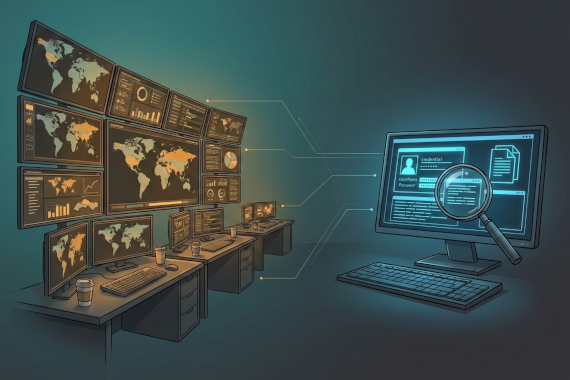
Compare how Recorded Future and Breachsense handle dark web monitoring differently.
• Recorded Future treats dark web monitoring as one module in a broader threat intelligence platform. Breachsense treats it as the entire product
• For credential depth and leaked document search, Breachsense goes deeper. For geopolitical context and strategic intelligence, Recorded Future has broader coverage
• Recorded Future needs dedicated analysts and months of setup. Breachsense integrates via API in hours
• If dark web monitoring is your primary need, Breachsense covers it without paying for geopolitical intelligence you don’t use
Recorded Future monitors the dark web as one piece of a much larger threat intelligence platform. Breachsense monitors the dark web as the core product.
That shapes everything from how deep each platform goes on credentials to how you get alerts.
Recorded Future gives you geopolitical context and strategic intelligence across 1 million+ sources. Breachsense gives you deep credential detection and an API built for automation.
This page compares both platforms specifically for dark web monitoring, not threat intelligence broadly.
How Does Recorded Future Handle Dark Web Monitoring?
Recorded Future is a threat intelligence platform that includes dark web monitoring as one of several intelligence modules. Mastercard acquired them in 2024 for $2.65 billion, but the platform still operates as a standalone product.
Their Intelligence Cloud indexes over 1 million sources across the open web and dark web. If you’re evaluating Recorded Future specifically for dark web monitoring, you’re buying a much bigger platform.
Threat intelligence platforms collect and analyze security data from multiple sources to help you understand who’s attacking you and how. Dark web monitoring is typically one module within a TI platform, alongside vulnerability intelligence and political risk analysis. Dark web monitoring is the most relevant module for credential exposure.
Recorded Future’s dark web coverage includes:
- 250+ dark web forums and sources monitored continuously
- Insikt Group research team providing analyst-backed context on dark web findings
- Identity Intelligence module detecting 1.3 million new exposed credentials per day
- AI and NLP analysis linking dark web activity to other threat sources
- Paste sites and criminal marketplaces where stolen data is sold
Recorded Future’s Dark Web Monitoring Strengths
Intelligence Graph. Recorded Future links dark web findings to other threat data like vulnerability intelligence and political risk analysis. A credential leak tied to a known APT group has more context than the same leak in isolation.
Massive source coverage. Indexing over 1 million sources means Recorded Future captures dark web data alongside open web signals. If an attacker discusses your company on a forum and also registers a lookalike domain, Recorded Future can connect those dots.
Where Recorded Future’s Dark Web Monitoring Falls Short
No full-text document search. Recorded Future alerts you when your data appears on the dark web but doesn’t index leaked files for search. If a vendor gets breached and your contracts are in the dump, Recorded Future can tell you the breach happened. It can’t let you search those files.
Dark web is one module, not the focus. Development resources are spread across geopolitical intelligence and vulnerability management. Credential coverage and stealer log monitoring may not go as deep as a platform that only does dark web monitoring.
Requires dedicated analysts. Recorded Future produces a high volume of intelligence. Without trained analysts to filter and interpret it, the data becomes noise. Implementation takes weeks to months.
Cost reflects the full platform. You’re paying for strategic intelligence and nation-state tracking even if you only need dark web monitoring. Breachsense prices for dark web monitoring alone.
How Does Breachsense Handle Dark Web Monitoring?
Breachsense is a dark web monitoring platform. It’s not a module within a larger product. The entire platform is built around detecting credentials and leaked documents on the dark web.
Credential intelligence tracks exposed passwords and session tokens across dark web sources. Unlike basic credential monitoring, you get context about how data was stolen and what else leaked alongside it. Breachsense monitors infostealer channels and ransomware gang leak sites as part of its dark web monitoring.
Breachsense monitors:
- Infostealer channels where malware like RedLine and Vidar dump harvested credentials
- Ransomware leak sites where attackers publish stolen files
- Hacker forums where attackers discuss targets and sell network access
- Breach dumps and combo lists from third-party breaches
- Unsecured databases like misconfigured Elasticsearch and MongoDB servers
- Paste sites where credentials are publicly posted
Breachsense’s Dark Web Monitoring Strengths
Full-text search on leaked documents. Breachsense indexes documents from ransomware attacks and third-party breaches. You can search for your company name or domain inside leaked files. If a vendor gets breached, you’ll find your data in the dump through third-party risk monitoring.
Real-time stealer log monitoring. Breachsense monitors infostealer channels as credentials are dumped. Session tokens that bypass MFA entirely are detected alongside passwords. You’re not waiting days for data processing.
Forum chatter monitoring. Breachsense tracks hacker forums where attackers discuss selling network access or sharing stolen data. Someone selling private VPN access to your network won’t show up in a credential dump. You’d only catch it by monitoring forum chatter.
API-first architecture. Every platform capability is available through the REST API. Webhooks push alerts to your existing tools. Teams building automated workflows or embedding dark web intelligence into products get native support.
Investigation and pivoting. Find a leaked user in a stealer log, then query their email to see every other service they logged into. Or query a password to find all other accounts using it. During incident response, a single alert becomes a full picture of what was compromised.
Unsecured database monitoring. Breachsense detects data exposed in misconfigured Elasticsearch and MongoDB servers. These aren’t breaches in the traditional sense, but your data is still sitting in the open.
Password cracking. Hashed passwords are cracked to plaintext so you know exactly which credentials need resetting. You’re not just told a hash was exposed.
How Do the Dark Web Monitoring Capabilities Compare?
Both platforms monitor the dark web. Here’s where they differ.
| Dark Web Capability | Recorded Future | Breachsense |
|---|
| Credential detection | ✓ | ✓ |
| Session token detection | ✓ | ✓ |
| Stealer log monitoring | ✓ | ✓ |
| Full-text document search | ✗ | ✓ |
| Forum chatter monitoring | ✓ | ✓ |
| Geopolitical intelligence | ✓ | ✗ |
| Nation-state tracking | ✓ | ✗ |
| Analyst-backed research | ✓ | ✓ |
| Unsecured database monitoring | ✗ | ✓ |
| API-first architecture | Partial | ✓ |
| Password cracking | ✗ | ✓ |
| Implementation time | Weeks to months | Hours |
Credential Coverage Depth
Both platforms detect credentials from stealer logs and breach dumps. Recorded Future’s Identity Intelligence module detects 1.3 million new credentials per day and includes VIP monitoring for executives.
Breachsense’s focus on this specific problem means deeper coverage of infostealer families and faster detection from stealer channels. It also adds the ability to pivot across data points during investigations, something you can’t do in a broad TI platform.
Recorded Future can’t search inside leaked files. You’ll know a breach happened, but you won’t be able to dig through the dump yourself.
Breachsense doesn’t cover geopolitical intelligence or nation-state tracking. If you need APT group attribution or political risk analysis, that’s outside its scope.
The two platforms solve different problems. Recorded Future wants to be your complete threat intelligence platform. Breachsense wants to be the best dark web monitoring tool.
Credential Exposure Response
When employee credentials appear in stealer logs or breach dumps, both platforms detect them. The difference is workflow.
Recorded Future surfaces credential alerts through their Identity Intelligence module alongside other threat types. Analysts review alerts in the same interface they use for strategic and vulnerability intelligence.
Breachsense delivers credential alerts via API and webhooks. Alerts flow directly into your SIEM or ticketing system. You can automate password resets without manual review. See the enterprise response playbook for workflow patterns.
Third-Party Breach Investigation
When a vendor gets hit with ransomware, you need to know if your data is in the dump.
Recorded Future can alert you that the breach happened and that your company may be affected.
Breachsense lets you search the actual leaked files. Type your company name and see what appears. Contracts and customer lists. You’ll know exactly what was exposed.
Multi-Tenant Dark Web Monitoring
MSSPs and security vendors need to monitor multiple clients from a single platform.
Breachsense was built for this. The API supports multi-tenant workflows natively. See the MSSP playbook for integration patterns.
Recorded Future serves enterprise customers and offers multi-tenant capabilities, but the platform is designed primarily for single-organization use with in-house security teams.
When Should You Choose Recorded Future?
Recorded Future fits when dark web monitoring is one piece of a larger threat intelligence program:
You need intelligence beyond the dark web. If your threat model includes geopolitical risk and nation-state actors, Recorded Future covers all of that in one platform. Breachsense doesn’t.
You have a threat intelligence team. Recorded Future produces high volumes of intelligence that trained analysts can turn into defensive action. Without that team, you won’t get full value.
You want one vendor for all threat intelligence. Recorded Future’s breadth means fewer vendor relationships and a single platform for dark web and geopolitical intelligence.
When Should You Choose Breachsense?
Breachsense fits when dark web monitoring is your primary need and you want depth over breadth:
Dark web monitoring is your core problem, not one piece of a bigger program. You don’t need geopolitical intelligence or vulnerability management bundled in. You need credential detection and leaked data search.
You’re building automated workflows. Breachsense’s API and webhooks let you pipe alerts straight into your SIEM or ticketing system. No analyst required for every alert.
You’re an MSSP or security vendor. Multi-tenant support and API-first design make Breachsense a data layer for security products, not just a dashboard to log into.
You need investigation depth. Pivoting across data points, searching leaked files, and catching exposed databases all come built in.
Yes. Recorded Future and Breachsense have limited overlap for dark web monitoring specifically.
A practical combination:
- Recorded Future for broad threat intelligence and strategic context
- Breachsense for deep credential monitoring and document search
You get threat intelligence breadth from Recorded Future and dark web depth from Breachsense. Whether the combined cost is justified depends on your threat model.
For most teams whose primary dark web concern is credential exposure and leaked data, Breachsense alone covers that thoroughly. If you also need strategic intelligence or nation-state tracking, Recorded Future adds coverage Breachsense doesn’t offer.
For a broader comparison beyond just dark web monitoring, see our Breachsense vs Recorded Future comparison.
Want to see what’s exposed on the dark web? Check your dark web exposure or book a demo to see Breachsense’s full-text document search in action.
Recorded Future vs Breachsense for Dark Web Monitoring FAQ
Recorded Future includes dark web monitoring as one module in their Intelligence Cloud. They monitor 250+ dark web forums and sources using AI and their Insikt Group research team. Dark web data feeds into a broader intelligence picture alongside geopolitical analysis.
Breachsense treats dark web monitoring as the core product. It monitors stealer channels and ransomware leak sites alongside hacker forums. It indexes the full text of leaked documents so you can search for your company data in ransomware dumps.
Recorded Future alerts you when your data appears in dark web sources but doesn’t let you search inside leaked files. Breachsense indexes documents from ransomware attacks so you can search for your company name or contracts inside those files.
Breachsense monitors infostealer channels in real time as credentials are dumped. Recorded Future detects credentials through their Identity Intelligence module. Both detect credentials, but Breachsense’s focused architecture means less processing delay.
For credential monitoring and leaked document search, yes. Breachsense covers the same stealer logs and breach dumps. It adds full-text document search and forum monitoring. If you also need geopolitical intelligence or nation-state tracking, you’d still need Recorded Future for that.
Yes. The platforms have limited overlap. Recorded Future handles broad threat intelligence and strategic context. Breachsense handles deep credential monitoring and document search. Some organizations use both to cover different needs.