Breachsense vs SpyCloud: Dark Web Monitoring Compared
Quick Summary
Pick SpyCloud for automatic password resets in Active Directory, Entra ID or Okta. Pick Breachsense for credential alerts plus searching leaked files and unsecured databases for your company data. Breachsense sends an alert when a leaked file mentions your company. It also sends alerts about new phishing domains and access brokers selling access to your network.
Last reviewed 5 November 2026. We checked every SpyCloud claim below against SpyCloud’s site and documentation that day.
What Does SpyCloud Do?
SpyCloud collects stolen credentials and session cookies to stop attackers taking over employee and customer accounts.
SpyCloud says its data lake holds more than 1 trillion recaptured identity assets, including 65.7 billion distinct identity records.
SpyCloud says it collects data from more than 110 malware families, mostly infostealers. It also collects passwords from phishing kits and combo lists.
SpyCloud’s Key Features
Data freshness. SpyCloud says breach data and phished credentials are available “within days” of SpyCloud collecting them. It says infostealer logs are processed “within hours to days”.
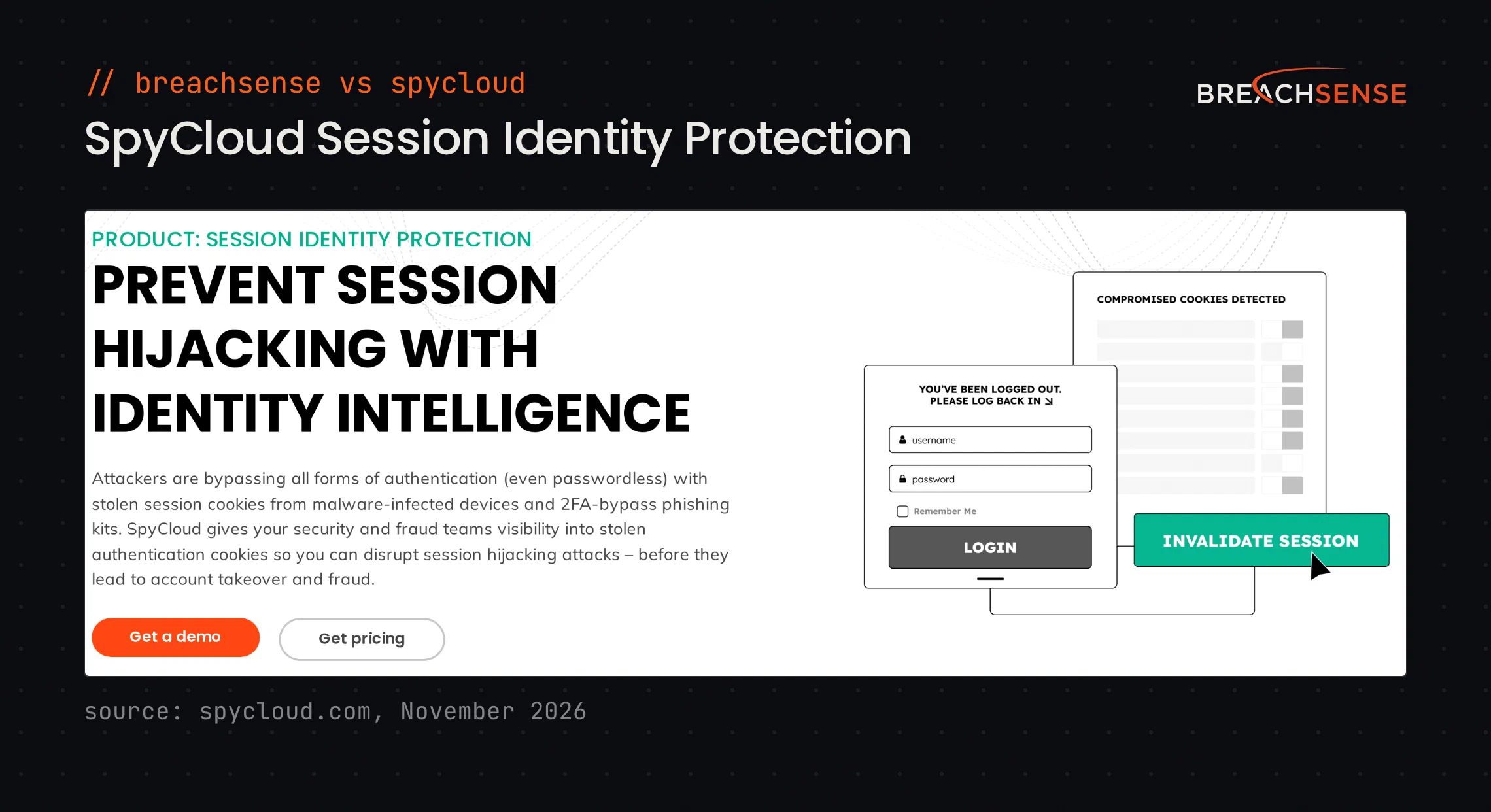
Session cookies. SpyCloud says it has recaptured more than 70 billion cookie records. It says session data typically reaches SpyCloud within hours of the theft. Its Session Identity Protection product flags stolen cookies for your company’s websites. That includes cookies from employee sign-ins through Okta or Entra ID. The product can then terminate the session or make the user sign in again.
Prebuilt integrations. SpyCloud has prebuilt integrations for SIEM (security information and event management) and SOAR (security orchestration, automation and response) tools. Examples include Microsoft Sentinel and Palo Alto Cortex XSOAR.
Vendor risk scores. SpyCloud’s Supply Chain Threat Protection gives each vendor an Identity Threat Index score. SpyCloud says the score weighs how many of the vendor’s employees were exposed and how recently. It also weighs how credible the source is and how severe the exposure was.
What Does Breachsense Do?
Breachsense monitors stolen credentials, leaked files, hacker forum posts and new domains that look like yours. We send alerts by webhook or email. Your tools can also pull our data from the API.
We collect stealer logs from malware such as StealC and Vidar. Our infostealer detection sends an alert when a stealer log contains your employees’ credentials. We also index the files ransomware groups publish on their leak sites.
Breachsense Key Features
Full-text search on leaked files. You can search files from ransomware leaks, third-party breaches and unsecured databases for your company data, such as your domain. When a term you monitor shows up in one of those files, we send an alert with the file’s URL.
Hacker forum monitoring. We send an alert when your company shows up in a hacker forum or dark web marketplace post.
Phishing kit passwords and MFA codes. We collect passwords employees typed into fake login pages. When the employee also typed a one-time MFA code, the alert includes it. A stolen MFA code means the attacker could have signed in. Reset the password and revoke the employee’s session tokens. Phishing alerts also include the URL of the fake login page. When the kit records which brand the page imitated, the alert includes the brand.
Phishing domain alerts. We send an alert when someone registers a domain that looks like yours. Our alerts cover typos, homoglyphs, other TLDs and your brand name plus a word, such as getexample.com.
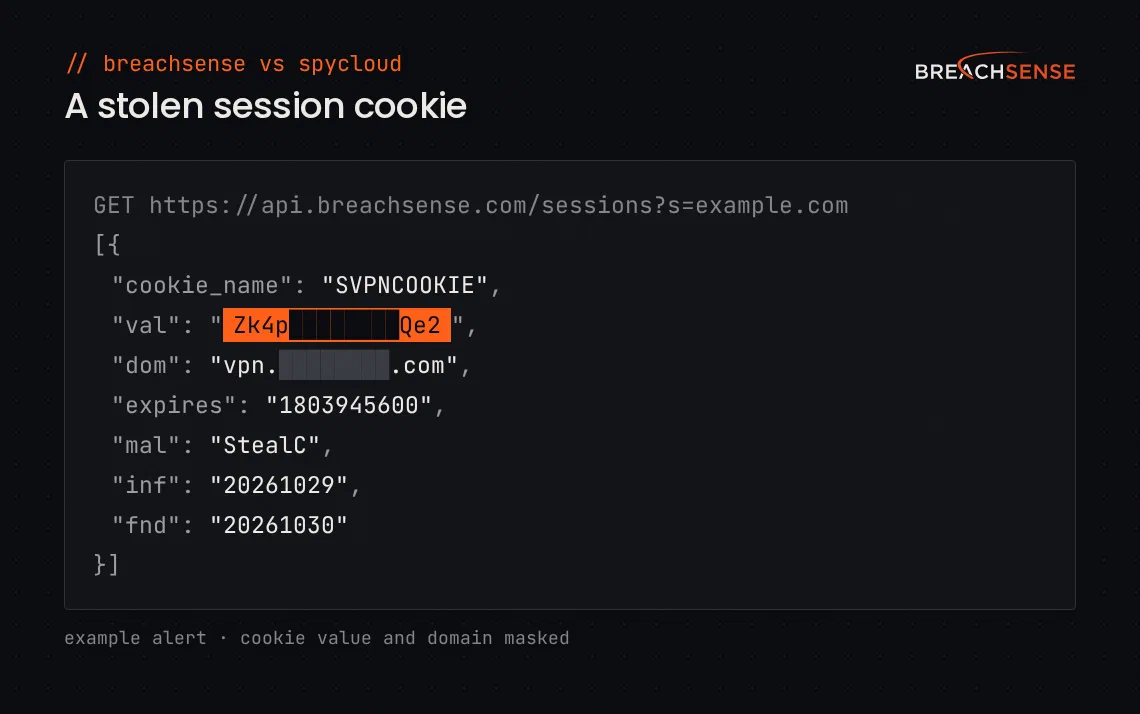
Stealer log coverage. Breachsense indexes new stealer logs within hours of them appearing on Telegram channels or criminal markets. We also collect the session cookies in those stealer logs. You choose which cookie names we monitor.
Password cracking. Hashed passwords are cracked to plaintext where possible, so you can check whether your employee still uses that password.
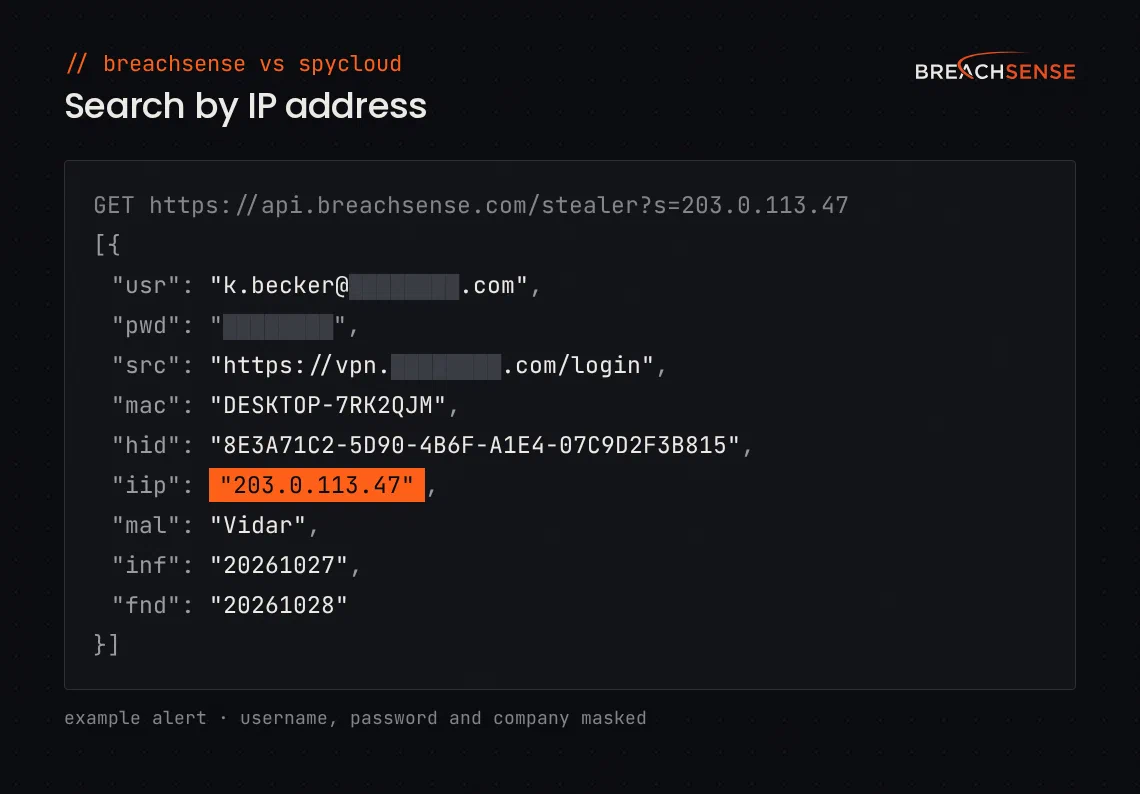
Pivoting from an alert. You can search the rest of our data by the IP address, email address or password in an alert. If an employee’s computer has infostealer malware, search by its IP address. You’ll see everything we found in stealer logs from that IP address, so you know which other accounts to reset. Search for an email address to find other passwords saved under it, across stealer logs, combo lists and third-party breaches. During incident response, you can also search by a leaked password to find other accounts where the employee reused it.
SpyCloud and Breachsense Compared Side by Side
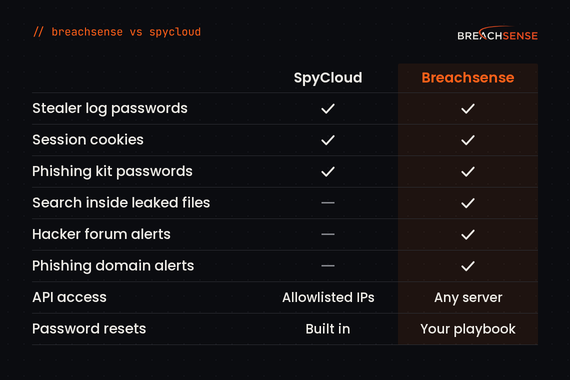
SpyCloud and Breachsense differ most in what happens after an alert and whether you can search leaked files.
| SpyCloud | Breachsense | |
|---|---|---|
| Data sources | Third-party breaches, infostealer malware, phishing kits and combo lists | Stealer logs, third-party breaches, combo lists, phishing kits, ransomware leak sites and hacker forums |
| Data format (plaintext credentials, raw session cookies) | Plaintext passwords, including ones cracked from password hashes, and stolen session cookies | Plaintext passwords, with password hashes cracked where possible, and raw stealer log cookies |
| Delivery | SpyCloud Console, email and webhook alerts, REST API with an IPv4 allow-list, SIEM, SOAR and identity provider integrations, and automatic resets | REST API in JSON or CSV, JSON webhooks and HTML email |
| Third-party breach and leaked-file coverage | Exposure data on vendors’ breached, phished or infected staff, with a risk score but no leaked-file search | Breach data, plus full-text search inside leaked files |
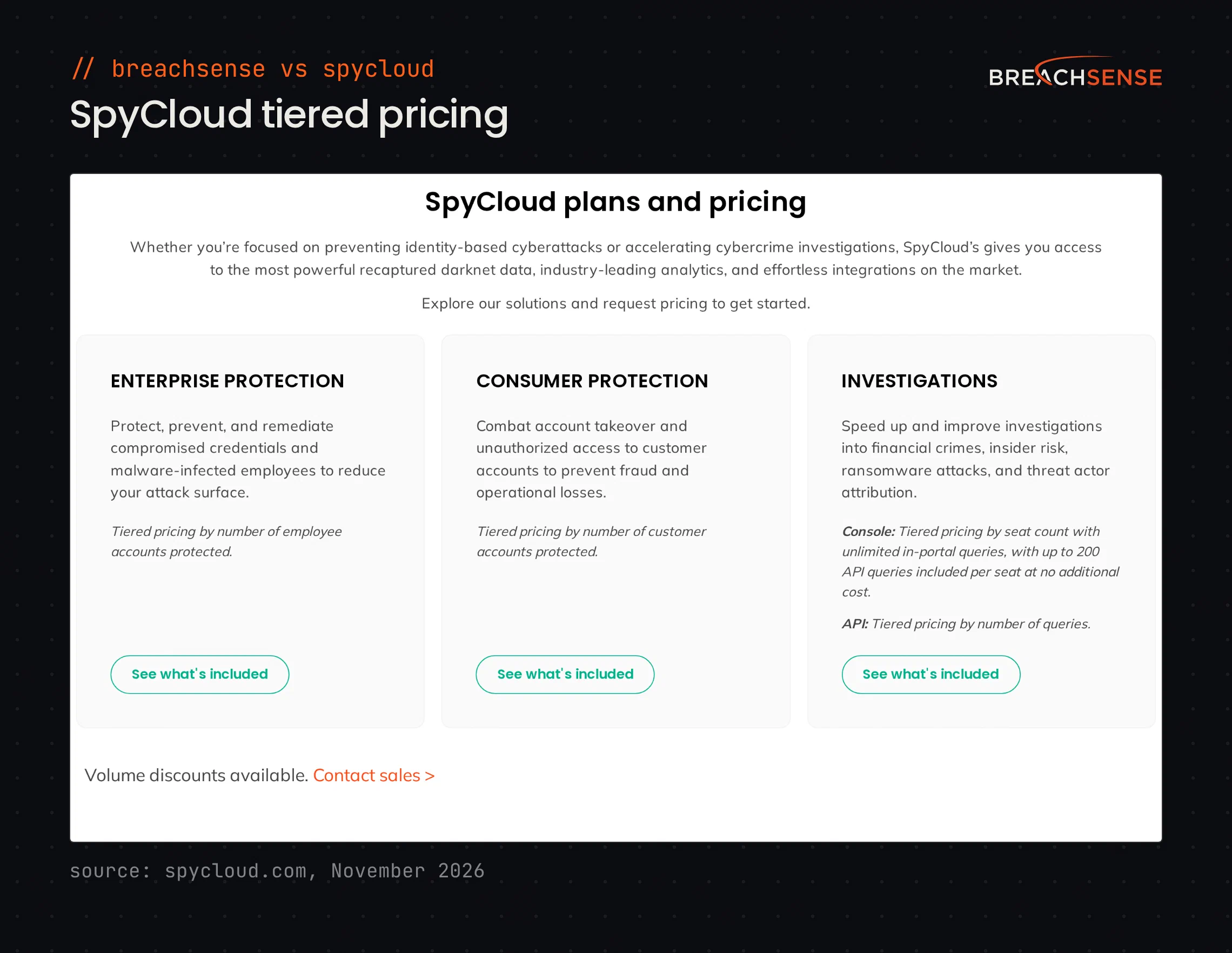
| Pricing model | “Tiered pricing by number of employee accounts protected”, and an MSSP minimum of $10,000 USD per month | “Your price depends on how many domains you monitor and how many API calls you make.” |
Credential Coverage
Both SpyCloud and Breachsense monitor these credential sources:
- Stealer logs from infostealer malware
- Third-party breach data
- Session tokens and cookies
- Combo lists
When SpyCloud finds a stolen session cookie, it can terminate the session for you. Our session cookie alert includes the cookie’s expiry date, so you know which sessions to revoke.
Full-Text Search on Leaked Documents
SpyCloud’s API looks up identity records by identifiers such as an email address or domain. None of SpyCloud’s API endpoints lets you search the text inside leaked files.
Breachsense indexes the text of files from ransomware attacks, third-party breaches and unsecured databases. You can search that text for any term, such as a project name. If a leaked file goes offline, you can still download its text from our backup.
Forum Chatter Monitoring
SpyCloud collects credentials from forums and Telegram. It doesn’t send alerts about forum posts.
Breachsense sends an alert when your company shows up in a hacker forum post, such as an access broker’s listing.
Integration and API
SpyCloud’s REST API only accepts calls from IPv4 addresses you’ve registered. SpyCloud Connect is a service whose engineers build custom SIEM, SOAR and identity provider integrations for you. SpyCloud says a standard deployment takes 2 to 4 weeks.
Breachsense’s API needs only a license key, so a new server can call it right away. Most teams connect our webhooks and API within hours. We include the alert type in each webhook, so your SOAR tool can start the right playbook. For a stealer log alert, the playbook can isolate the infected computer so IT can clean it before resetting passwords. For a leaked-file alert, the playbook can open a ticket for an analyst to review the file.
When Isn’t Credential Intelligence Enough?
Credential intelligence means finding stolen passwords and session tokens on the dark web before attackers can use them.
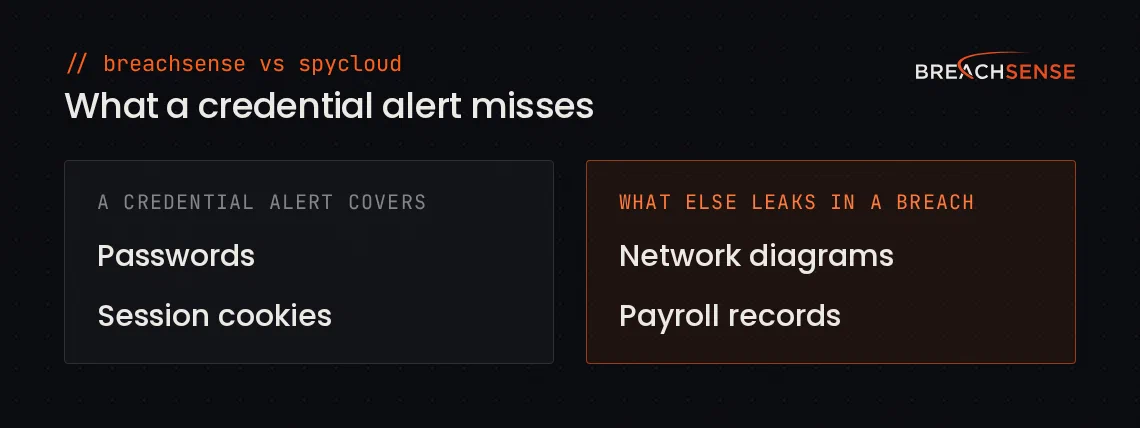
Leaked documents. When a vendor gets hit with ransomware, the attacker publishes internal files. An IT provider’s leaked files can include your network diagrams and admin passwords. A payroll provider’s leaked files can include your employees’ salaries and bank details. Leaked files can also contain API keys that let an attacker call your cloud services directly. Breachsense lets you search a vendor’s leaked files for your company data.
Forum discussions. Access brokers sell access to company networks on hacker forums. A credential alert won’t tell you about those posts.
Leak site posts. When a ransomware group lists one of your vendors, we send an alert with the victim page’s URL. The alert can include a screenshot of the page, so you don’t have to open the leak site yourself.
Unsecured databases. Our leaked-file search covers the unsecured databases we find.
Phishing domains. A phishing kit alert comes only after an employee types a password into a fake login page. An alert on a newly registered domain that looks like yours can come first.
For a broader look at how different tools compare, see our credential monitoring tools list.
Who SpyCloud Suits Best
SpyCloud suits teams that want a vendor to reset passwords and revoke sessions for them.
You want to review alerts in a web console. The SpyCloud Console lets your analysts review alerts without building an integration.
Your analysts investigate cases such as financial crime or ransomware attacks. SpyCloud’s Cybercrime Investigations console has unlimited queries, so analysts can search as often as a case needs. It’s priced per seat.
You want employees’ personal accounts monitored. SpyCloud’s IDLink ties an employee’s personal accounts to their work identity.
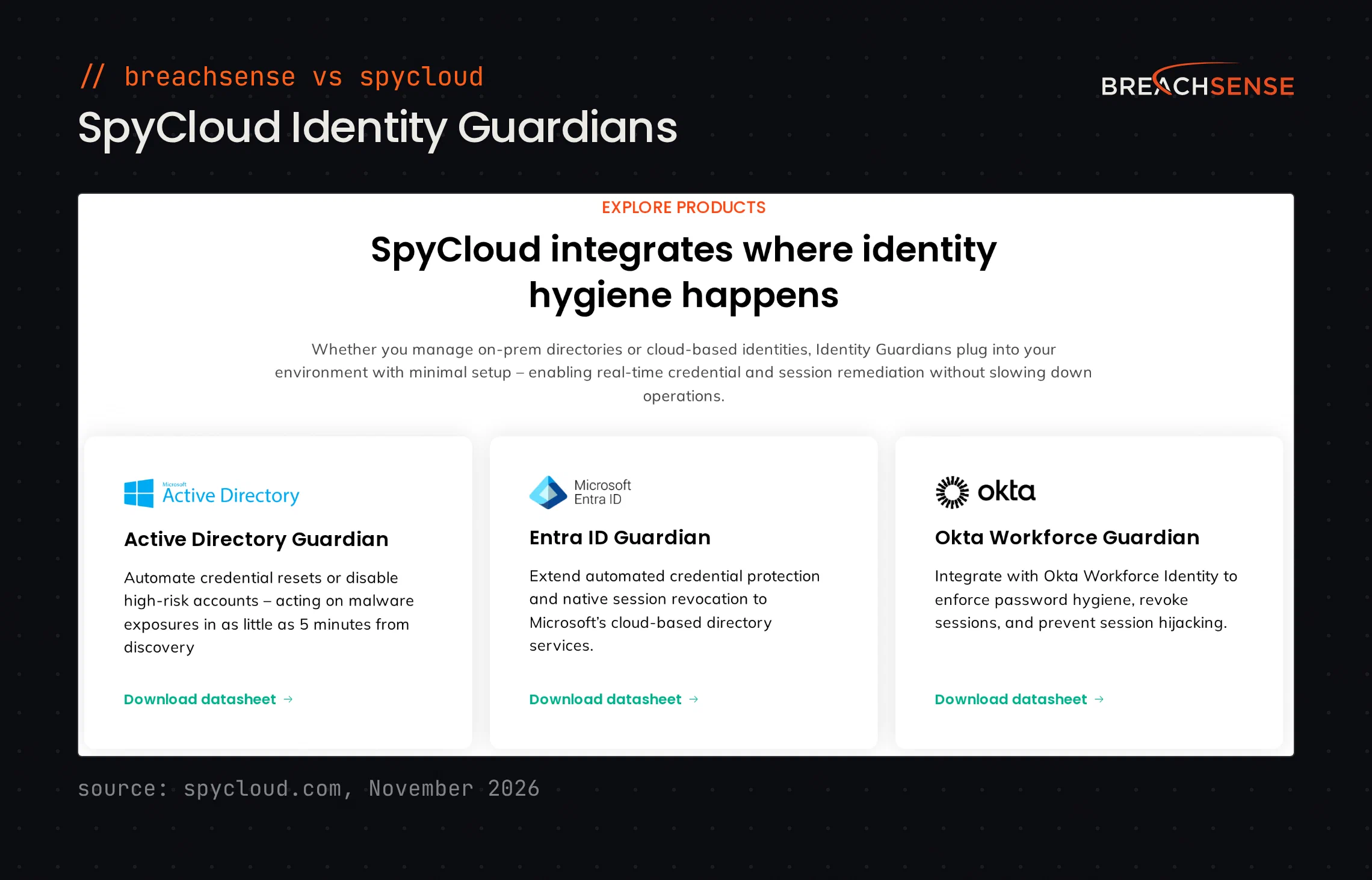
You want exposed accounts fixed for you. SpyCloud’s Identity Guardians reset exposed passwords automatically in Active Directory, Entra ID and Okta. The Entra ID and Okta Guardians also revoke stolen sessions. The Active Directory Guardian can also disable the account. SpyCloud says a reset can happen “in as little as 5 minutes from discovery”.
Who Breachsense Suits Best
Breachsense suits teams that want the alert data and decide how to act on it themselves.
You need to search leaked documents. Our third-party risk monitoring lets you search breached vendors’ files for your company data.
You want to know when an access broker lists access to your network for sale. Our forum alerts include a screenshot of the post. Your team doesn’t need an account on the forum to read it.
You want to know when someone registers a domain that looks like yours. If the domain hosts a phishing site, we can file a takedown request.
You’re building a security product. Your product can query our REST API for leaked credentials and files. We send new alerts to it by webhook.
You want to decide how each alert is handled. Our skill for Claude Code, Codex and GitHub Copilot lets your AI assistant write a playbook for each alert type. For example, a playbook for phishing alerts can reset the phished password in your identity provider.
You’re an MSSP (managed security service provider). Our dark web monitoring for MSPs lets you add all your clients to one account. You can send each client’s alerts to that client’s own email address or webhook.
Choosing Between SpyCloud and Breachsense
Choose SpyCloud if you want leaked passwords reset automatically in Active Directory, Entra ID or Okta.
Choose Breachsense if you want credential alerts plus alerts about leaked files, forum posts and new phishing domains.
Check your domain for leaked credentials or book a demo to see our leaked-file search and phishing domain alerts. In each vendor’s demo, ask to see an alert for your domain or a client’s. Check whether session cookie alerts include the cookie’s expiry date. A trial is available after a demo call.