Target Data Breach Case Study: Causes and Lessons Learned
What Happened in the Target Data Breach? The Target data breach of 2013 remains one of the most studied cyberattacks in …

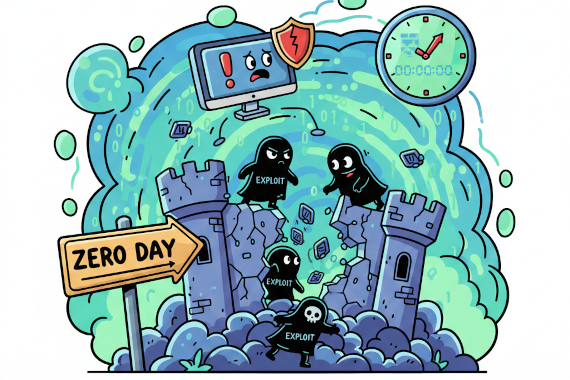
Learn how zero-day exploits work and what your security team can do to reduce the blast radius.
• Zero-day exploits target unknown vulnerabilities before vendors release patches, giving defenders no time to prepare
• Enterprise security products like VPNs and firewalls are now prime targets for zero-day attacks
• Nation-states and ransomware gangs are the primary zero-day threat actors with very different motivations
• Defense requires layered security since you can’t patch vulnerabilities you don’t know exist
Zero-day exploits are every security team’s nightmare. A vulnerability nobody knows about. No patch available. Attackers already inside. In 2024 alone, 75 zero-day vulnerabilities were exploited in the wild. The window between discovery and weaponization has collapsed from weeks to just 5 days.
The shift toward enterprise targeting makes this personal for security teams. VPNs and firewalls are now prime targets. Security appliances too. When attackers exploit these systems, they bypass your perimeter entirely.
This guide breaks down how zero-day exploits work and who’s behind them. We’ll cover practical defenses your team can implement today, famous examples from Stuxnet to MOVEit, plus current statistics on the evolving threat landscape.
Whether you’re a SOC analyst tracking active exploits or a CISO presenting risk to the board, understanding zero-days is essential for modern security operations.
A zero-day exploit takes advantage of a software vulnerability that nobody knows about yet. The vendor hasn’t released a patch. Security tools don’t have signatures for it. Your defenses are essentially blind.
A zero-day exploit is attack code that targets a previously unknown software vulnerability. The name comes from the fact that vendors have had zero days to develop and release a fix. Until the vulnerability is discovered and patched, every system running the affected software remains exposed.
The terminology can get confusing. Here’s how the three related terms differ:
Think of it like this: the vulnerability is the unlocked door, the exploit is the technique for opening it, and the attack is the burglary itself.
Traditional security relies on knowing what to block. Antivirus needs signatures. Firewalls need rules. Intrusion detection needs patterns. Zero-day exploits bypass all of this because the threat is unknown.
When a zero-day hits, you’re playing defense without knowing the opponent’s playbook. That’s why these vulnerabilities command premium prices on underground markets. According to MIT Technology Review research, a working zero-day for widely-used software can sell for $500,000 or more.
Zero-day attacks follow a predictable lifecycle, even though the specific vulnerability changes. Understanding this process helps security teams prepare defenses and recognize attacks in progress.
The zero-day attack lifecycle describes how vulnerabilities move from discovery to active exploitation. It typically includes discovery, exploit development, weaponization, attack execution, and eventually disclosure and patching. The window between weaponization and patching is when organizations are most vulnerable.
Someone finds a flaw in software. This could be a security researcher or a government agency. Criminal groups find them too. The discoverer decides what to do with the information. Ethical researchers report to vendors. Others sell to the highest bidder or use it themselves.
Nation-state actors often stockpile zero-days for future operations. Commercial surveillance vendors develop them for government clients. Criminal groups either develop their own or purchase from underground markets.
Raw vulnerability knowledge isn’t enough. Someone must write code that reliably triggers the flaw and achieves a useful outcome like code execution or privilege escalation. This requires significant technical skill.
Exploit development can take days or months depending on the vulnerability’s complexity. Some flaws are straightforward to exploit. Others require bypassing multiple security mechanisms.
The exploit gets packaged for deployment. For targeted attacks, this might mean embedding it in a phishing email or malicious document. For mass exploitation, attackers might scan the internet for vulnerable systems.
Here’s the critical statistic: Attackers now weaponize vulnerabilities in just 5 days on average. This is down from 32 days in previous years according to Google’s Threat Intelligence Group. The window for patching before exploitation has essentially collapsed.
The attacker executes the exploit against target systems. Successful exploitation typically provides initial access. From there, attackers establish persistence and move laterally toward their ultimate objective. That might be data theft or ransomware deployment. Espionage is another common goal.
Zero-day exploitation is rarely the end goal. It’s the entry point. What happens next depends on the attacker’s motivation.
Eventually, the vulnerability becomes known. Security researchers might discover it independently. Incident responders might find it during breach investigation. The vendor develops a patch, releases it, and the race begins between defenders applying updates and attackers targeting the remaining unpatched systems.
Even after patches are available, exploitation often continues for months. Many organizations are slow to update, especially for complex enterprise software.
Zero-day attacks have shaped cybersecurity history. These examples illustrate the range of threat actors and their targets.
Stuxnet remains the most sophisticated zero-day attack ever documented. It used four separate Windows zero-days to target Iranian nuclear facilities. The malware specifically attacked Siemens industrial control systems running uranium enrichment centrifuges.
Stuxnet caused physical destruction, making centrifuges spin out of control while reporting normal operations to monitoring systems. An estimated 1,000 centrifuges were destroyed. The attack, widely attributed to the United States and Israel, demonstrated that zero-days could be weapons of cyber warfare.
Heartbleed exploited a flaw in OpenSSL, the cryptographic library securing much of the internet. The vulnerability allowed attackers to read sensitive memory from affected servers, potentially exposing passwords and encryption keys.
Unlike targeted zero-days, Heartbleed affected an estimated 500,000 servers globally. The widespread impact demonstrated how a single vulnerability in foundational software can create massive systemic risk.
EternalBlue was a zero-day exploit developed by the NSA. When it leaked online through the Shadow Brokers group, it became the foundation for WannaCry ransomware.
WannaCry spread automatically across networks, encrypting files and demanding a ransom. It infected over 200,000 systems across 150 countries in days. The UK’s National Health Service was hit particularly hard, with hospitals forced to turn away patients. The attack caused billions in damage globally.
Log4Shell targeted Apache Log4j, a Java logging library used in countless applications. The vulnerability was trivial to exploit and provided remote code execution. At its peak, security firms observed over 100 attacks per minute targeting Log4Shell.
The vulnerability received a severity rating of 10 out of 10. What made it particularly dangerous was Log4j’s prevalence. It’s embedded in everything from cloud services to enterprise applications. Many organizations still don’t know everywhere Log4j runs in their environment.
The Cl0p ransomware gang discovered and exploited a zero-day in MOVEit Transfer, a popular file transfer solution. Before Progress Software released a patch, Cl0p had already compromised thousands of organizations.
The attack hit government agencies and universities. Healthcare providers and major corporations were compromised too. Cl0p used the access to steal data and extort victims. The cascade effect demonstrated how supply chain zero-days can impact organizations that never directly used the vulnerable software.
Multiple zero-day vulnerabilities in Ivanti Connect Secure VPN appliances were exploited by Chinese state-sponsored actors. CISA issued emergency directives requiring federal agencies to disconnect affected devices.
This attack is a perfect example of the trend toward targeting enterprise security products. By compromising VPNs, attackers bypass perimeter defenses entirely.
Zero-day attacks require significant resources and technical capability. The threat actors fall into distinct categories with different motivations.
Government hacking groups are the most prolific zero-day users. China leads the pack with the most attributed exploits. Russia follows close behind, often focusing on Ukrainian targets. These groups conduct espionage and intellectual property theft. Some aim for destruction, like Russia’s NotPetya attack that caused over $10 billion in global damage.
Nation-states can afford to stockpile zero-days. They have dedicated vulnerability research programs and the patience for long-term operations. Their targets include government agencies and defense contractors. Critical infrastructure is also in the crosshairs.
Criminal groups increasingly use zero-days when the payoff justifies the cost. Ransomware gangs like Cl0p have demonstrated willingness to purchase or develop zero-days for mass exploitation campaigns.
For criminals, zero-days provide scale. A single exploit can compromise thousands of organizations simultaneously. The MOVEit attack showed how profitable this approach can be.
Companies like NSO Group sell zero-day exploits to government clients. These tools target mobile devices for surveillance purposes. While marketed for law enforcement, they’ve been used against journalists and activists. Political opponents are also targeted.
Commercial spyware represents a gray market for zero-days. The buyers are governments, but the targets often include civilians.
Initial access brokers (IABs) sometimes sell zero-day-based access to compromised networks. Rather than exploiting victims directly, they specialize in gaining initial access and selling it to ransomware operators and other criminals.
Zero-days are premium inventory for IABs. Access gained through zero-day exploitation is valuable because victims often don’t realize they’ve been compromised.
The targeting pattern has shifted dramatically. Enterprise security products are now prime targets.
44% of 2024 zero-days targeted enterprise security products according to Mandiant research. VPNs and firewalls accounted for 60% of these enterprise-focused attacks.
This makes strategic sense for attackers. Compromising a VPN appliance provides direct network access. Firewalls see all traffic. Security tools have elevated privileges. These products are also harder to patch since updates often require maintenance windows.
Consumer-facing zero-days still exist, but they’re expensive and quickly patched. Browser zero-days primarily target Chrome and Safari. Mobile zero-days hit iOS and Android. These are particularly valuable for surveillance operations.
Nation-state actors target government networks and critical infrastructure. Defense contractors are also high on the list. These attacks support espionage and strategic objectives rather than financial gain.
Companies with valuable data attract well-resourced attackers. Financial institutions hold data worth stealing. Healthcare organizations can’t afford downtime. The potential payoff justifies the investment in advanced exploits.
Detecting zero-days requires shifting from signature-based to behavior-based security. You’re looking for anomalies rather than known patterns.
Zero-day exploitation creates observable side effects. Unusual process execution and unexpected network connections can indicate exploitation even without specific signatures. Abnormal system calls are another red flag.
User and entity behavior analytics (UEBA) can identify compromised accounts by detecting behavioral deviations. If an attacker uses zero-day access to move laterally, their behavior patterns will differ from legitimate users.
EDR platforms monitor endpoint activity in detail. They can detect malicious behavior regardless of whether the triggering exploit is known. Process injection and anomalous child processes are common signs. Suspicious PowerShell execution is another red flag.
When zero-days are exploited, the post-exploitation activity follows recognizable patterns. EDR catches attackers during lateral movement and privilege escalation. Data exfiltration attempts are flagged too.
Threat intelligence provides early warning when zero-days emerge. Security vendors share indicators of compromise. Government agencies issue advisories. Dark web monitoring can reveal when attackers discuss new exploits.
Subscribe to threat feeds covering your software stack. When a zero-day drops, you need to know immediately.
Even when attackers use zero-days to breach networks, they often need valid credentials for persistent access. Monitoring for exposed credentials provides an additional detection layer. If your employees’ passwords appear in dark web markets or stealer logs, attackers may already have network access.
Zero-day exploitation often produces distinctive network patterns. Command and control communication creates traffic anomalies. So does data exfiltration. Network detection and response (NDR) tools can identify these patterns.
Perfect protection is impossible. You can’t patch vulnerabilities you don’t know exist. But you can dramatically reduce both the likelihood and impact of zero-day attacks.
This sounds obvious, but patching is still foundational. Once zero-days become known, the clock starts. Organizations that patch quickly face far less risk than those with months-long patch cycles.
Prioritize patches for internet-facing systems and security products. These are the highest-value targets.
Every piece of software is a potential attack surface. Remove applications you don’t need. Disable features you don’t use. The less code running, the fewer potential zero-days.
Shadow IT makes this harder. Employees spin up unauthorized apps and services that security teams never see. Attack surface management helps you find these blind spots before attackers do.
This is especially important for enterprise software. Legacy applications and unused services accumulate vulnerabilities over time.
Zero trust assumes breach. It requires verification for every access request regardless of network location. When zero-days provide initial access, zero trust limits what attackers can do next.
Network segmentation and least-privilege access reduce the blast radius of successful exploitation. Continuous verification helps too.
Zero-day exploits get attackers through the door. Stolen credentials help them stay undetected. When attackers establish persistence, they often create new accounts or steal existing credentials.
Monitoring for exposed credentials catches this activity. If your organization’s credentials appear in breach data or stealer logs, investigate immediately. The credential exposure might indicate active compromise.
Assume that zero-day attacks will eventually succeed. Build incident response capabilities to detect and contain breaches. Recovery planning matters too. Tabletop exercises should include zero-day scenarios.
Know your critical assets. Know your network architecture. Know who to call when things go wrong.
Zero-day exploits represent the cutting edge of offensive security. Unknown vulnerabilities. No patches available. Attackers with days or weeks of head start. The 5-day average weaponization window leaves almost no time to react.
The threat landscape has evolved. Enterprise security products are now priority targets. VPNs and firewalls that once protected networks are now attack vectors. Nation-states and ransomware gangs use zero-days to achieve their objectives. Surveillance vendors do too.
Defense requires accepting that prevention isn’t always possible. Layer your security. Detect behavioral anomalies. Monitor for credential exposure. Assume breach and plan accordingly.
Zero-days get attackers in the door. What happens next depends on your defense-in-depth. Even when initial exploitation succeeds, you can limit the damage through segmentation and monitoring. Rapid response makes a difference too.
Start by assessing your current exposure. Check whether your organization’s credentials have already been compromised. Monitor dark web channels where zero-day exploits get discussed and sold. Build the early warning capabilities that give you a fighting chance.
A zero-day exploit is code that takes advantage of a software vulnerability unknown to the vendor. The term ‘zero-day’ refers to the fact that developers have had zero days to fix the flaw because they don’t know it exists. This gives attackers a significant advantage since no patch or defense is available. Zero-day exploits are highly valued on criminal markets because they guarantee initial access to target systems.
The MOVEit Transfer attack in 2023 is a prime example. The Cl0p ransomware gang discovered a zero-day SQL injection vulnerability in MOVEit’s file transfer software. Before Progress Software could patch it, Cl0p had already compromised thousands of organizations. Government agencies and universities were hit hard. So were major corporations. The attack demonstrated how a single zero-day can cascade across entire supply chains.
Yes, AI is increasingly used to discover zero-day vulnerabilities. Google’s Big Sleep AI model found a previously unknown buffer overflow in SQLite in late 2024. Both attackers and defenders use machine learning for fuzzing and code analysis. However, AI-discovered zero-days cut both ways. Security researchers use them to patch vulnerabilities faster. Attackers use them to find exploitable flaws. The race between AI-assisted offense and defense is accelerating.
Zero-day exploits are more common than most organizations realize. Google tracked 75 zero-days exploited in the wild during 2024. The first half of 2025 saw a 46% increase over the same period in 2024. Over 7,300 zero-day vulnerabilities have been documented since 1988. While not every organization faces targeted zero-day attacks, widely-used software zero-days like Log4Shell affect millions of systems simultaneously.
You can’t prevent zero-day attacks entirely, but you can reduce their impact. Start with attack surface reduction by removing unnecessary software and services. Implement network segmentation to limit lateral movement. Deploy endpoint detection and response (EDR) tools that catch suspicious behavior regardless of known signatures. Monitor for compromised credentials since attackers often chain zero-days with stolen access. Finally, maintain an incident response plan that assumes breach.
Detecting zero-day attacks requires behavioral analysis rather than signature-based detection. Look for anomalous process execution and unusual network connections. Unexpected system changes are red flags too. EDR platforms that monitor endpoint behavior can catch zero-day exploitation even without specific signatures. Dark web monitoring can provide early warning when attackers discuss new exploits. Threat intelligence feeds help you track which vulnerabilities are being actively exploited.
What Happened in the Target Data Breach? The Target data breach of 2013 remains one of the most studied cyberattacks in …
Threat Intelligence Cybersecurity CTI Security Operations
What Is the Threat Intelligence Lifecycle? The threat intelligence lifecycle is a six-phase process that turns raw …