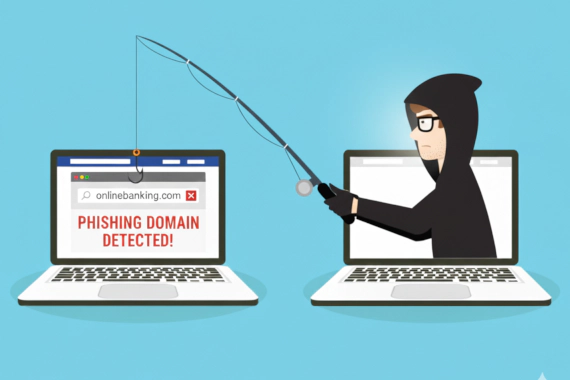
Phishing Domains: Detect Lookalike Sites Before Attacks
Phishing Domain Security Typosquatting Brand Protection Credential Theft
What Are Phishing Domains? Attackers don’t need to hack your network when they can trick your employees into handing …


Learn how typosquatting attacks steal employee credentials through fake domains and how to detect them before damage is done.
• Typosquatting uses lookalike domains with minor misspellings to trick users into entering credentials on fake login pages
• Your employees are targets: 75% of typosquatted domains impersonate Google, Microsoft, and Amazon services your workforce uses daily
• Detection requires continuous monitoring since attackers register thousands of malicious lookalike domains monthly
• Combine defensive domain registration with dark web monitoring to catch stolen credentials before exploitation
One wrong keystroke. That’s all it takes. An employee types ‘ofice.com’ instead of ‘office.com’ and lands on a perfect replica of the login page. They enter their credentials. Attackers now own their account.
Zscaler ThreatLabz analyzed over 30,000 lookalike domains in six months and found more than 10,000 were malicious. These weren’t sophisticated zero-days. They were simple typos exploited by attackers who registered domains that look almost identical to legitimate ones.
Typosquatting is embarrassingly effective. It bypasses email security, endpoint protection, and user training because it exploits human error, not technical vulnerabilities. Your employees are one mistyped URL away from handing over their credentials.
The internet runs on trust. You type a URL, hit enter, and expect to land where you intended. Typosquatters exploit that trust.
Typosquatting is a social engineering attack where threat actors register domain names that closely resemble legitimate websites, using common typos, character substitutions, or alternative spellings. When users accidentally visit these fake domains, attackers harvest credentials, distribute malware, or commit ad fraud. Also known as URL hijacking.
The attack works because humans make predictable mistakes. We transpose letters. We miss keystrokes. We confuse similar-looking characters. Attackers know this and register domains that capture these errors.
The attack lifecycle is deceptively simple. An attacker identifies a high-value target domain, generates hundreds of typo variations, registers the most promising ones, and drives victims to them through phishing emails, malicious ads, or social engineering.
Step 1: Target Selection
Attackers focus on domains with high traffic and valuable credentials. Banking sites, email providers, corporate portals, and e-commerce platforms top the list. Zscaler’s 2024 research found Google targeted in 28.8% of typosquatting attempts, Microsoft in 23.6%, and Amazon in 22.3%. These three brands account for nearly 75% of all typosquatting activity.
Step 2: Domain Generation
Tools like dnstwist generate thousands of domain permutations automatically. For a single target domain, these tools create variations using character substitution, transposition, missing letters, extra letters, and wrong TLDs. Dnstwist generates thousands of permutations for a typical corporate domain.
Step 3: Infrastructure Setup
Attackers register the most convincing domains and obtain SSL certificates to display the padlock icon that users associate with security. Nearly half of phishing domains use free Let’s Encrypt certificates, according to Zscaler’s analysis.
Step 4: Credential Harvesting
The fake site replicates the legitimate login page pixel-for-pixel. When users enter credentials, the site either captures them and displays an error message, or passes them through to the real site while logging them. Either way, attackers now have valid credentials.
This entire process costs attackers almost nothing but yields high-value credentials that sell for premium prices on dark web markets.
Attackers use several techniques to create convincing fake domains. Understanding these patterns helps security teams identify and block threats proactively.
This technique replaces letters with visually similar characters. The classic example is substituting ‘rn’ for ’m’ because they look nearly identical in most fonts. ‘rnicrosoft.com’ looks like ‘microsoft.com’ at a glance. Other substitutions include ‘1’ for ’l’, ‘0’ for ‘o’, and ‘vv’ for ‘w’.
Attackers remove or add single characters that users might miss. ‘gogle.com’ (missing ‘o’), ‘googgle.com’ (extra ‘g’), and ‘microsft.com’ (missing ‘o’) all exploit common typing errors. These domains catch users who type quickly without proofreading.
Swapping adjacent letters creates domains like ‘googel.com’ or ‘amazno.com’. These target the specific muscle memory errors people make when typing familiar URLs quickly.
Users often default to ‘.com’ even when the legitimate site uses a different extension. Attackers register ‘amazon.co’ or ‘google.net’ to capture this traffic. Country-code TLDs like ‘.cm’ (Cameroon) are popular because they look like typos of ‘.com’.
Adding or removing hyphens creates plausible-looking domains like ‘face-book.com’ or combining brand names with common words like ‘amazon-deals.com’. This technique, called combosquatting, extends typosquatting into brand impersonation territory.
Each technique targets different user behaviors, so attackers often register multiple variations to maximize their catch rate.
Here’s what these attacks actually look like when they hit real companies.
The Microsoft Impersonation Campaign
The domain ‘rnicrosoft.com’ targeted Microsoft 365 users by replacing ’m’ with ‘rn’. The swap was nearly invisible in most fonts, and even harder to spot on mobile where the address bar cuts off the full URL. The phishing emails mirrored Microsoft’s official logo, layout, and tone. Victims who entered credentials handed them directly to attackers.
Facebook’s $2.8 Million Lawsuit
Facebook successfully sued domain squatters who registered hundreds of variations of ‘facebook.com’. The court awarded $2.8 million in damages under ACPA, establishing precedent for aggressive legal action against typosquatters. This remains one of the largest public judgments in a typosquatting case.
Election Interference Domains
During the 2020 US presidential election, researchers identified over 500 typosquatted domains targeting candidate websites. Some hosted disinformation. Others harvested donor credentials. Several redirected visitors to malicious Chrome extensions. Typosquatting scales to target any high-profile event.
Financial Sector Targeting
Recorded Future analyzed a major US financial institution and found 226 possible typosquatted domains, with 91 actively registered. Of those, 52 had associated mail servers capable of receiving email, suggesting business email compromise preparation. Eight different malware families were linked to the hosting infrastructure.
These examples show typosquatting isn’t theoretical. It’s an active, profitable attack vector. And you’re a target.
Attackers invest in typosquatting because it works. Here’s what they’re after.
Typosquatting protection involves proactively defending against domain impersonation through defensive registration, continuous monitoring, and rapid takedown processes. Effective protection combines DNS filtering to block fake domains with credential monitoring to catch stolen passwords before attackers use them.
Credential Harvesting
The primary goal is stealing usernames and passwords. Fake login pages capture credentials that attackers use directly or sell on dark web forums. Corporate credentials are especially valuable because they provide access to internal systems, email, and sensitive data. These stolen credentials often appear in combo lists.
Malware Distribution
Typosquatted domains serve as malware infrastructure. In 2024, Unit 42 discovered a Linux variant of the Bifrost RAT using ‘vmfare.com’ as its command-and-control server. The typosquatted domain helped the malware blend in with legitimate VMware traffic.
Phishing Campaign Infrastructure
Typosquatted domains provide convincing infrastructure for spear phishing campaigns. Email links to ‘amaz0n.com’ or ‘paypal.co’ look legitimate enough to bypass casual inspection. The domains add credibility to social engineering attacks.
Ad Fraud and Traffic Monetization
Some typosquatters simply monetize mistyped traffic through advertising. Users who land on parking pages covered in ads generate revenue for the domain owner. It’s less harmful than credential theft, but the domain still infringes on the brand’s trademark.
Competitive Disruption
Occasionally, typosquatting targets competitors. A company might register a lookalike of a competitor’s domain to redirect their traffic or display negative content. It’s rare compared to credential theft, but it happens.
Detection requires proactive monitoring because attackers register new domains all the time. Waiting for users to report suspicious sites means waiting until after their credentials are compromised.
Domain Permutation Monitoring
Tools like dnstwist generate possible typosquatted versions of your domain. Periodically run the script to find which domain permeations have been registered and resolve to an IP address. Security teams should monitor not just exact typos but also combosquatting variations that combine your brand name with common words.
Certificate Transparency Logs
Every SSL certificate issued gets logged publicly. Monitoring these logs for certificates matching your brand name catches typosquatters when they set up their infrastructure. Services like crt.sh provide free certificate transparency searches.
DNS Query Analysis
Analyzing DNS queries from your network to find employees visiting typosquatted domains. Spikes in queries to suspicious lookalike domains indicate active attacks or successful phishing campaigns.
Dark Web Credential Monitoring
When typosquatting attacks succeed, stolen credentials eventually appear on criminal marketplaces and forums. Dark web monitoring detects your organization’s credentials before attackers exploit them, providing a second line of defense when prevention fails.
User Reports and Security Awareness
Train your employees to verify URLs before entering credentials and report anything suspicious. When they flag a fake login page, you get early warning. CISA’s phishing guidance is a good starting point.
When it comes to stopping typosquatting attacks, there’s no silver bullet. You need layers.
Register common misspellings, character substitutions, and TLD variations of your primary domains. This prevents attackers from registering them instead. Focus on high-value variations that users are most likely to mistype. Remember, the cost of defensive registrations is far lower than the cost of a successful attack.
DNS Filtering: Block access to known typosquatted domains at the network level. Free options like Quad9 or Cloudflare’s 1.1.1.1 for Families provide basic protection. For enterprise coverage, services like Cisco Umbrella and Cloudflare Gateway offer more comprehensive blocklists.
Email Security: Configure email gateways to scan URLs and block messages containing links to known typosquatted domains. Most enterprise email security products include this capability.
Browser Protection: Chrome, Firefox, and Safari use Google Safe Browsing to warn users about phishing sites. Microsoft Edge has Website Typo Protection specifically for typosquatted domains. Encourage employees to keep browser protections enabled.
DMARC/DKIM/SPF: Implement email authentication to prevent attackers from spoofing your domain in phishing campaigns that direct victims to typosquatted sites.
Continuous monitoring catches new typosquatted domains before they’re used in attacks. External attack surface management finds phishing domains impersonating your brand as well.
When credentials do get stolen, compromised credential monitoring detects them on dark web marketplaces. This enables password resets before attackers use the stolen credentials.
Train employees to bookmark frequently used sites instead of typing URLs. Teach them to verify the address bar before entering credentials. Phishing simulations that include typosquatted domains test whether training is effective.
Users make mistakes. That’s why technical controls are your first line of defense. Training helps, but don’t rely on it alone.
Finding a typosquatted domain targeting your organization requires immediate action. Speed matters because every hour the domain stays active means more potential victims.
Document Everything
Screenshot the typosquatted site and record the domain registration details using WHOIS lookup. Note the registrar, creation date, and nameservers. This evidence supports legal action and takedown requests.
Check for Credential Compromise
Search your breach monitoring tools for any credentials associated with the typosquatted domain. If employees visited the site and entered credentials, initiate password resets immediately. Check login logs for suspicious authentication attempts from unusual locations.
Block the Domain
Add the typosquatted domain to your DNS blocklist, web proxy blocklist, and email security blocklist. This prevents additional employees from falling victim while you work on the takedown.
File Takedown Requests
Report the domain to the registrar’s abuse contact. Most registrars have policies against phishing and will suspend obviously malicious domains. For trademark-infringing domains, file a UDRP complaint through ICANN or pursue legal action under ACPA.
Monitor for Related Domains
Attackers rarely register just one domain. Search for other variations that might be part of the same campaign. Check certificate transparency logs for certificates issued to similar domains around the same time.
Alert Affected Users
If customers or partners might have visited the typosquatted site, notify them immediately. Provide clear instructions for checking whether their credentials were compromised and how to protect themselves.
Taking these steps quickly limits damage and establishes a process for handling future incidents.
Typosquatting works because humans are predictable. Users type URLs from memory, make the same mistakes, and trust familiar-looking login pages. Attackers capitalize on every one of these tendencies. And they do it at scale.
Over 10,000 malicious lookalike domains discovered in six months. Three brands accounting for 75% of all impersonation attempts. Nearly half of phishing sites using free SSL certificates to appear legitimate.
So how do you fight back? Prevention and detection. Register defensive domains to block attackers from acquiring them. Implement DNS filtering and email security to catch typosquatted links. Train users to verify URLs before entering credentials.
But prevention isn’t enough. When attacks succeed, you need to know immediately. Dark web monitoring detects stolen credentials, giving you time to reset passwords and limit the damage.
Your employees are one typo away from credential theft right now. Check your organization’s dark web exposure to see what credentials are already circulating on criminal marketplaces.
Businesses should combine defensive domain registration with continuous monitoring. Register common misspellings and TLD variations of your primary domain. Implement DNS filtering to block known typosquatted domains. Use dark web monitoring to detect when credentials stolen via typosquatted phishing sites appear for sale. Train employees to bookmark critical sites rather than typing URLs.
Bookmark frequently used sites instead of typing URLs. Check the address bar before entering credentials on any login page. Look for HTTPS and valid SSL certificates, though attackers increasingly use Let’s Encrypt for free certificates. Use password managers that auto-fill only on legitimate domains. Keep browser security features enabled, like Google Safe Browsing in Chrome or Website Typo Protection in Edge.
Typosquatting is a social engineering attack where threat actors register domains that mimic legitimate websites using common typos, character substitutions, or TLD variations. When users accidentally visit these fake sites, attackers harvest credentials, distribute malware, or redirect traffic for ad fraud. Also called URL hijacking.
Multi-layered defense works best: email security gateways with URL scanning, DNS filtering to block malicious domains, security awareness training, and compromised credential monitoring to detect when employee passwords appear in breach databases. No single control stops all phishing. Credential monitoring catches successful attacks before exploitation.
In the US, the Anticybersquatting Consumer Protection Act (ACPA) allows trademark holders to sue for damages up to $100,000 per domain. Internationally, ICANN’s Uniform Domain-Name Dispute-Resolution Policy (UDRP) enables trademark holders to reclaim domains. Facebook won a $2.8 million judgment against domain squatters using this legal framework.
Register common misspellings, character substitutions, and alternative TLDs for your primary domain. Monitor certificate transparency logs for new certificates issued to similar domains. Use brand monitoring services to detect new registrations. File UDRP complaints or ACPA lawsuits against infringing domains. Consider joining ICANN’s Trademark Clearinghouse for early notification of similar domain registrations.
Phishing Domain Security Typosquatting Brand Protection Credential Theft
What Are Phishing Domains? Attackers don’t need to hack your network when they can trick your employees into handing …
Data Breach Prevention Threat Intelligence Best Practices
What Is Phishing Protection Software? When attackers want to steal credentials, they register domains that look almost …