Types of Threat Intelligence: Which One Actually Prevents Breaches?
Learn how the different types of threat intelligence prevent breaches when integrated correctly.
• There are four intelligence types (strategic, operational, tactical, technical) and each serves a different audience at a different speed. Your board needs to know where to invest next year. Your SOC analyst needs IPs to block right now. Sending the wrong type to the wrong person is how CTI programs waste money.
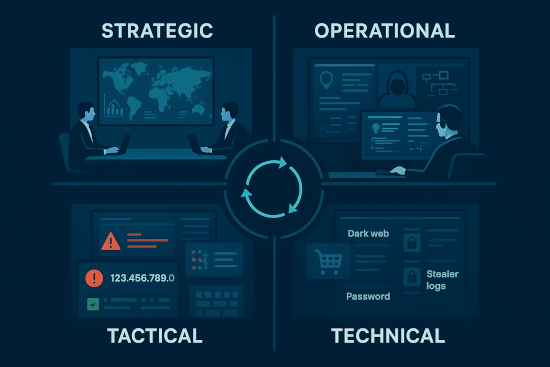
• No single intelligence type tells the full story. Strategic tells you third-party breaches are doubling. Operational explains which group is behind it and how they get in. Tactical gives your tools the IOCs to block. Technical feeds your EDR the detection signatures. Break the connection between any two and you have data instead of intelligence.
• You don’t need all four types on day one. Small teams should start with tactical (automated IOC blocking) and credential monitoring. Add operational when your SOC can use campaign context for hunting. Add strategic when leadership needs data for budget decisions.
• Most teams over-invest in tactical IOCs and skip operational intelligence entirely. Tactical IOCs expire in hours. Operational intelligence about how an attacker group operates stays useful for months and makes your detection rules smarter. If your feeds only deliver IPs to block without explaining why, you’re always one step behind.
Most security teams subscribe to threat feeds and call it a threat intelligence program. It’s not. Feeds give you data. Intelligence gives you context about what the data means for your company.
The difference matters because each type of threat intelligence serves a different audience with a different timeframe. Your CISO needs different intelligence than your SOC analyst. Confusing the two is how teams spend six figures on feeds and still can’t answer basic questions about their risk.
This guide breaks down the types of cyber threat intelligence, how they work together, and which ones you should prioritize based on your team’s size and maturity.
What Is Cyber Threat Intelligence?
There’s a difference between having threat feeds and having threat intelligence. Most teams have the first and think they have the second.
Cyber threat intelligence (CTI) is analyzed information about threats to your company, enriched with context about who’s attacking and what you should do about it. Raw IOC feeds are data. Intelligence tells you what the data means for your specific environment.
The progression matters:
Threat data: “This IP is malicious.”
Threat information: “This IP was used in a phishing campaign last week.”
Threat intelligence: “This IP is part of a ransomware group’s C2 infrastructure. They’re exploiting the same VPN software you run. Block the IP and audit VPN access logs. Check if any employee credentials appeared in recent stealer logs.”
One is a list. The other tells you what to do.
That’s why types of cyber threat intelligence exist. Your CISO and your SOC analyst don’t need the same thing, and they can’t wait the same amount of time for it.
What Are the Types of Threat Intelligence?
There are four threat intelligence types. Here’s what each one does and who it’s for.
Strategic Threat Intelligence
Audience: CISOs, board members, executives | Timeframe: Months to years
Strategic intelligence answers business questions. Not “which IP to block” but “where should we invest next year?”
Real-world example: The Verizon 2025 DBIR showed third-party breaches doubled from 15% to 30% of all incidents. That’s strategic intelligence. It tells a CISO they need to invest in vendor risk monitoring. It gives them the data to justify the budget to the board.
Strategic intelligence doesn’t tell anyone what to block. It tells leadership where to spend money and which risks are growing. For a deep dive, see our strategic threat intelligence guide.
Operational Threat Intelligence
Audience: SOC managers, threat hunters | Timeframe: Weeks to months
Operational intelligence reveals how attackers operate. Not individual IOCs but the full picture: who’s attacking, what techniques they use, what they’re after.
Real-world example: “A ransomware group is actively exploiting Citrix vulnerabilities in companies running the same version you use. They buy stolen VPN credentials from initial access brokers who source them from infostealer logs. Average time from initial access to encryption is 4 days.”
That tells your SOC manager to prioritize Citrix patching and write detection rules for the specific TTPs. It also justifies a threat hunt for early indicators.
Operational intelligence has the longest useful lifespan of the non-strategic types. Attackers change their infrastructure (IPs, domains) constantly, but they rarely change their techniques. MITRE ATT&CK maps these techniques so your team can track them systematically. Understanding how a group operates stays useful for months.
Tactical Threat Intelligence
Audience: SOC analysts, security tools | Timeframe: Hours to days
Tactical intelligence is what most people think of when they hear “threat intelligence.” Specific IOCs your tools can act on immediately. The tactical vs strategic distinction matters because they serve completely different audiences on completely different timescales.
Indicators of Compromise (IOCs) are specific technical artifacts like malicious IP addresses and file hashes that indicate a system has been compromised. SOC analysts use IOCs to detect and block active threats.
Real-world example: “Block these C2 IPs associated with the ransomware group described in the operational brief above. Here are the file hashes for their encryption tool and lateral movement scripts.”
The catch: tactical intelligence has the shortest shelf life. Attackers rotate infrastructure constantly. An IP that’s malicious today might be clean tomorrow. If you’re only consuming tactical intelligence, you’re permanently one step behind.
Technical Threat Intelligence
Sometimes treated as a subset of tactical, technical intelligence covers the most granular artifacts: malware signatures, exploit code, registry keys, network packet patterns.
Real-world example: “This malware sample drops a DLL in %APPDATA%\Roaming and establishes persistence through a scheduled task named ‘WindowsUpdate’. It communicates with C2 on port 8443 using a custom protocol.”
Technical intelligence is primarily consumed by automated tools and malware analysts. It’s what feeds your IDS signatures and EDR detection rules. Most security teams consume it indirectly through their tools rather than analyzing it directly.
How Do the Types of Threat Intelligence Work Together?
No single intelligence type tells the full story. Here’s how they connect.
Say dark web monitoring detects a spike in stolen credentials from companies using a specific cloud platform. That’s the starting point. Here’s how each intelligence type picks it up:
Strategic: “Credential theft targeting this cloud platform increased 3x this quarter. We need to evaluate our exposure and consider additional monitoring.” This reaches the CISO and informs a budget conversation.
Operational: “A specific attacker group is harvesting credentials through infostealer malware distributed via fake software updates. They sell the credentials to ransomware affiliates within 48 hours.” This reaches the SOC manager who adjusts hunting priorities and detection rules.
Tactical: “Block these 12 C2 domains used for credential exfiltration. Here are the file hashes for the infostealer variant.” This reaches the SOC analyst who updates firewall rules and runs a retroactive hunt.
Technical: “The infostealer reads Chrome’s Login Data SQLite database and decrypts stored passwords using this method. Here’s the YARA rule to detect it.” This reaches the EDR platform automatically.
Break the connection between any two types and you lose context. Block the C2 IPs (tactical) without understanding the campaign (operational) and you don’t know to hunt for the infostealer already on your endpoints. Understand the campaign (operational) but lack executive buy-in (strategic) and you can’t get budget for the monitoring tools you need.
Which Type Should You Start With?
Not every team needs all four types. Your starting point depends on your team size and what decisions you need to support.
Small teams (1-5 security staff): Start with tactical intelligence. Automated IOC blocking through a threat intelligence platform gives you immediate protection without requiring dedicated analysts. Add credential monitoring to catch stolen passwords from devices you don’t control.
Mid-size teams (5-20 security staff): Add operational intelligence. Your SOC can use campaign context to write better detection rules and run targeted threat hunts. This is where you shift from reactive blocking to understanding attacker behavior.
Enterprise teams (20+ security staff): Add strategic intelligence for board reporting and budget justification. At this scale, you also need the threat intelligence lifecycle running as a formal process with feedback loops. See our threat intelligence management guide for the operational details.
The industry pushes “comprehensive CTI programs” because vendors make more money selling all types. But if you have two security people, buying strategic reports about geopolitical threats is a waste of resources. Focus on what your team can actually act on.
Conclusion
Each intelligence type serves a specific audience at a specific speed.
Strategic tells leadership where to invest. Operational tells your SOC what to hunt for. Tactical tells your tools what to block. Technical feeds automated detection. None of them does the others’ job.
Start with what your team can act on. Expand as you grow. The goal isn’t collecting all types. It’s making sure the right intelligence reaches the right people in time to prevent the breach.
Credential monitoring is a good starting point for most teams because stolen credentials drive a large share of breaches. Book a demo to see how Breachsense fits into your threat intelligence stack.