Recorded Future Pricing (2026): Packages and How It's Priced

Quick Summary
Recorded Future doesn’t publish prices. A Recorded Future quote depends on the package, your company’s size, add-ons, services and extra capacity. Size is based on how many workforce credentials, such as employee logins, your company has.
| Package | What you get | Mainly priced by |
|---|---|---|
| Core | Threat and malware research, vulnerability prioritization, brand impersonation alerts and leaked employee credentials | Company size, or number of users |
| Professional | Everything in Core, plus automated threat hunting and discovery of your internet-facing systems | Company size |
| Elite | Everything in Professional, plus vendor monitoring and vendor security ratings | Company size |
What Goes Into a Recorded Future Quote
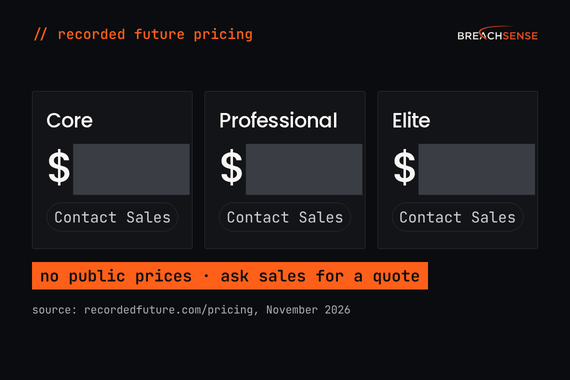
Recorded Future’s pricing page lists three Platform Packages (Core, Professional and Elite). Each package has a “Contact Sales” button where a price would be.
For most packages, your company’s size is the main factor in the price. The number of vendors you monitor, assets you scan and API calls you make each day also count.
The package and licensing details on this page come from Recorded Future’s pricing page and its Packages & Licensing PDF.
Why Listen to Us?
Breachsense has indexed over 44 billion leaked credentials from stealer logs, combo lists, phishing kits and third-party breaches. Josh Amishav founded Breachsense in 2018. He’s a penetration tester with nearly 20 years of offensive security work for financial institutions and government agencies.
TechTarget and the Center for Internet Security’s MS-ISAC (Multi-State Information Sharing and Analysis Center) have cited our ransomware research.
How Much Does Recorded Future Cost?
Recorded Future doesn’t publish what its packages cost. The company’s FAQ says prices vary because each customer buys a different mix of package, size, services and capacity.
For most packages, Recorded Future prices you by your number of unique workforce credentials, such as employee logins. Recorded Future puts that number into a price band called a workforce tier. With a workforce tier, any number of your staff can use the platform.
Your company may grow past its workforce tier’s cap during the contract. If it does, you may have to buy extra capacity.
The workforce tier also caps how many of your company’s credentials Recorded Future monitors for leaks.
Smaller teams can pay per user rather than by company size. Recorded Future calls this named-user licensing.
Standard Support comes with every package at no extra cost. Premium Success costs extra. It gives you your own technical contact at Recorded Future, plus product training.
What’s in Each Recorded Future Package?
Recorded Future’s FAQ says, “For most customers, we recommend a Platform Package.” Core, Professional and Elite are those Platform Packages.
Core
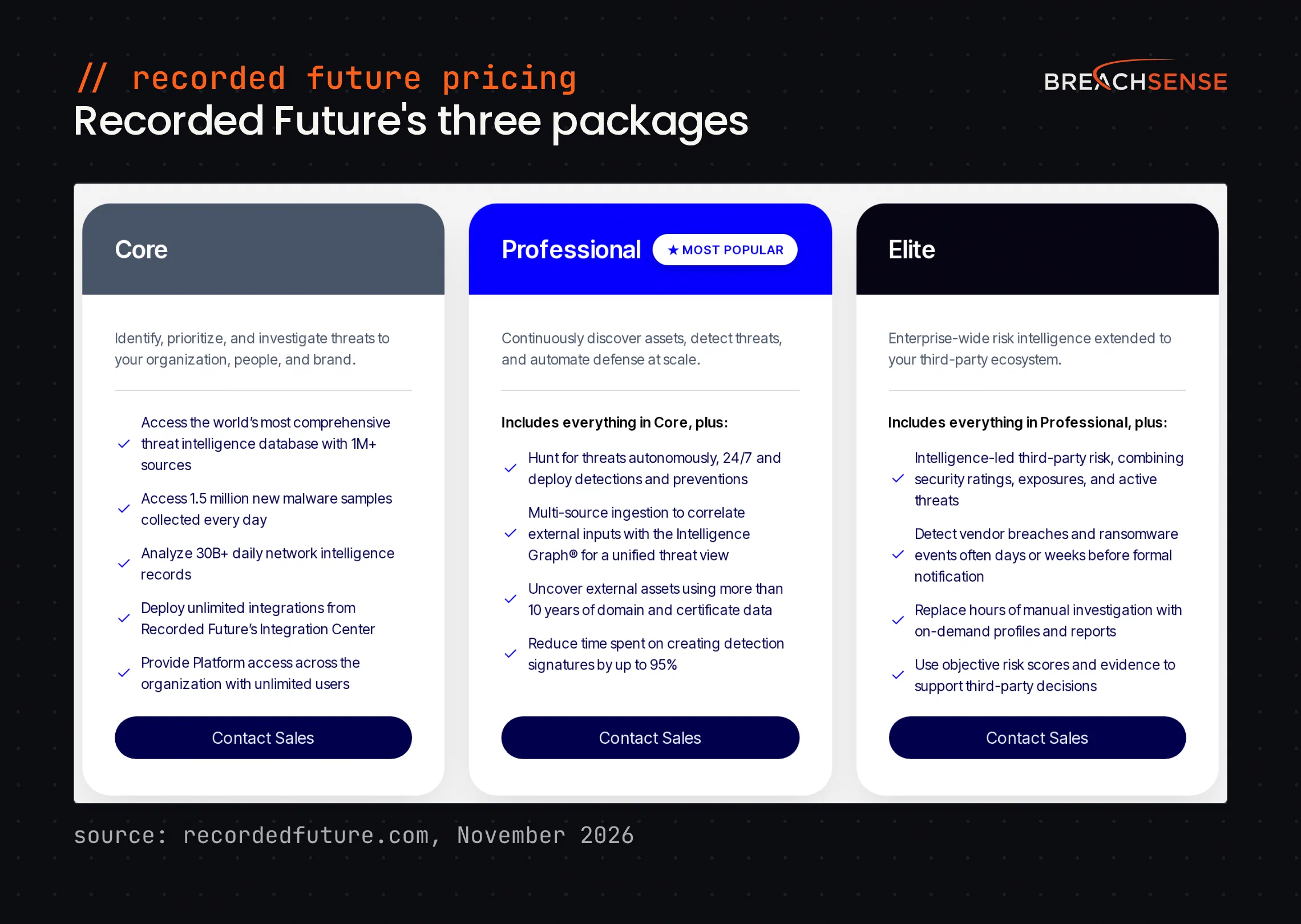
Recorded Future says Core collects threat data from more than a million sources. Core also adds 1.5 million new malware samples a day. You can connect Core to as many of your tools as you like through Recorded Future’s Integration Center.
The licensing PDF calls Core’s leaked-credential monitoring Identity Intelligence. It covers your employees’ leaked credentials, including ones found in stealer logs.
Brand monitoring covers a maximum of 250 of your executives and five of your logos.
Professional
Recorded Future’s pricing page labels Professional “Most popular”. Professional adds automated threat hunting around the clock. Recorded Future also deploys detection rules to your security tools. Recorded Future says Professional cuts the time spent writing detection rules by up to 95%. Professional also pushes malicious IP addresses and other indicators to your security tools for blocking.
Professional can also pull in threat data you get from other sources. You then see that data next to Recorded Future’s own. To find your internet-facing systems, the package uses more than 10 years of domain and certificate records.
The licensing PDF calls the threat hunting Autonomous Threat Operations. It calls the discovery of your internet-facing systems Attack Surface Intelligence. Among the Platform Packages, only Core can be priced per user.
Elite
Elite adds monitoring of your vendors. Recorded Future sends an alert when a vendor’s credentials leak. You also get an alert when the vendor has a data breach or a ransomware attack. You can view a profile and report for any vendor. Recorded Future says Elite also gives you a risk score for each vendor, with the evidence behind it.
The licensing PDF says Elite adds Third-Party Intelligence and RiskRecon Advisor. RiskRecon Advisor tracks each vendor’s security rating.
Elite caps how many vendors you can monitor. If you have hundreds of vendors, ask how many the quote covers.
Recorded Future Solution Packages and Add-Ons
A Solution Package covers one part of the platform. Examples are Digital Risk Protection (brand impersonation and leaked employee credentials) and Third-Party Risk (vendor monitoring). You can buy Solution Packages on their own or add them to a Platform Package, according to Recorded Future’s FAQ.
The pricing page lists four Solution Packages:
- Cyber Operations, for threat, vulnerability and malware intelligence, priced by company size or number of users
- Digital Risk Protection, for brand impersonation and your employees’ leaked credentials
- Third-Party Risk, for your vendors’ breaches and security ratings
- Payment Fraud, for compromised cards and checks
The licensing PDF lists these add-ons:
| Add-on | What it does | Priced by |
|---|---|---|
| Attack Surface Intelligence | Finds unknown internet-facing systems and ranks which ones are most at risk | Number of hostnames and IP addresses scanned |
| Autonomous Threat Operations | Automated threat hunting, with detection rules sent to your security tools | A flat fee |
| Third-Party Intelligence | Sends an alert when a vendor’s credentials leak, or when the vendor has a breach or ransomware attack | Number of vendors monitored |
| RiskRecon Advisor | Tracks each vendor’s security rating | Number of vendors monitored |
| External Identity | Monitors leaked credentials of your customers and other outside users | Number of outside accounts monitored |
| Geopolitical Intelligence | Tracks geopolitical events, physical threats and country risk | A flat fee, or number of users |
| Enterprise Sandbox | Detonates malware while keeping the malware samples inside your company | Malware samples analyzed per day |
Not every add-on works with every package, according to the licensing PDF. You can add Autonomous Threat Operations only to Core or Cyber Operations. RiskRecon Advisor can only be added to Third-Party Intelligence.
What Determines Your Recorded Future Price?
Recorded Future’s licensing PDF defines seven pricing metrics.
| Pricing metric | What it counts |
|---|---|
| Workforce tier | Unique workforce credentials across your company and its affiliates |
| Workforce identities | A fixed number of workforce credentials monitored for leaks, bought instead of a workforce tier |
| Named users | People allowed to use the platform |
| Monitored organizations | The vendors and other organizations you track |
| Scanned assets | Hostnames and IP addresses in an attack surface project |
| External identities | Credentials that aren’t on your own domains, such as customer accounts |
| API calls | Your maximum number of API calls a day |
By default, Recorded Future prices each metric in tiers. A tier is a range with its own price and cap. Recorded Future looks at your highest usage, not your average. So estimate each metric at its peak during the contract.
Looking up a company in the web interface doesn’t count toward your monitored organizations.
Recorded Future gives each customer one daily API call limit. That limit covers every Recorded Future API and every call to its MCP (Model Context Protocol) server. The default is 5,000 calls a day, unless your order form says otherwise. If you buy several packages, you get the highest of their limits, not the total. You can buy more calls separately.
Affiliates count toward your tiers. Recorded Future defines an affiliate as any company that controls you or that you control. Sister companies owned by the same parent count too.
How to Get a Recorded Future Quote
To get a quote, use the Contact Sales button on the Recorded Future pricing page. Recorded Future’s value calculator doesn’t show prices either. It estimates the time and money threat intelligence saves your company.
Have these answers ready before the call:
- Your count of unique workforce credentials, including your affiliates
- What you need Recorded Future for, such as threat research, brand protection or vendor monitoring
- How many vendors you’ll monitor, and how many external assets you’ll scan
- Your expected daily API calls
- Whether paying per user would work for you
- Whether you want Premium Success, or Standard Support is enough
Ask the sales team which tier each number falls into. Also ask what counts as a workforce credential. The licensing PDF doesn’t say whether contractors or shared mailboxes are included.
Where Breachsense Fits
Breachsense is a dark web monitoring API for security teams and MSSPs (managed security service providers). We’re a good fit if finding your company’s leaked data is the main reason you’re looking at Recorded Future.
Your tools can pull our data from the dark web monitoring API as JSON or CSV. We send webhook alerts to your SIEM (security information and event management) or SOAR (security orchestration, automation and response) tool. Each credential alert includes the leaked password, cracked from its password hash where we can. With the plaintext password, you can check whether the employee still uses it. Stealer log alerts include the infection date when the log records it. MSSPs can set an email address or webhook for each watchlist item, so each client’s alerts go to that client.
We also find passwords that employees typed into phishing pages, stolen session tokens and leaked API keys. You can search files leaked in ransomware attacks, third-party breaches and unsecured databases for your company’s data.
We don’t replace Recorded Future’s geopolitical, malware or vulnerability intelligence. To compare Recorded Future with Flashpoint, Flare and other options, see our Recorded Future alternatives page.
Our pricing is based on how many assets you monitor and the data sources you need. It also depends on how many API requests you send each month. A trial is available after a demo call.
Price Recorded Future Against What You Need to Monitor
If you only need vendor monitoring, ask for quotes on both Elite and the Third-Party Risk Solution Package. If you need threat research and vendor monitoring, Elite covers both in one package.
If you mainly need to find your company’s leaked data, book a demo. On the call, we’ll show you leaked credentials for your domains. We’ll learn your requirements, then put together a package that covers only what you need.