Levels of Threat Intelligence: Why 62% of Organizations Can't Make CTI Work
Learn how to integrate all three threat intelligence levels so your program keeps its funding.
• Threat intelligence levels aren’t menu options. They’re dependencies. Tactical intelligence without strategic direction is noise, and strategic intelligence without tactical implementation is a slideshow.
• Most organizations spend 80% of their CTI budget on tactical feeds (shortest lifespan) and 10% on strategic analysis (highest business impact). The financial pyramid is upside down.
• Integration requires top-down direction from strategic priorities and bottom-up feedback from tactical detections. Without that loop, you can’t prove value.
• Small teams actually have an advantage here. One security team wearing all three hats avoids the silos that kill enterprise CTI programs.
93% of organizations have cyber threat intelligence programs. Only 55% can measure whether they actually work.
The problem? Most teams treat intelligence levels as a menu. Pick tactical because it feels productive. Block threats around the clock. Check the box.
Then the board asks ‘What’s our biggest long-term risk?’ Nobody has an answer. Funding gets cut. The cycle repeats.
This guide breaks down the three levels of threat intelligence, how they connect, and how to integrate them so you can show the board what the money bought.
What Do We Mean by Levels of Threat Intelligence?
Cyber threat intelligence (CTI) isn’t one thing. It’s three layers that serve different people with different time horizons.
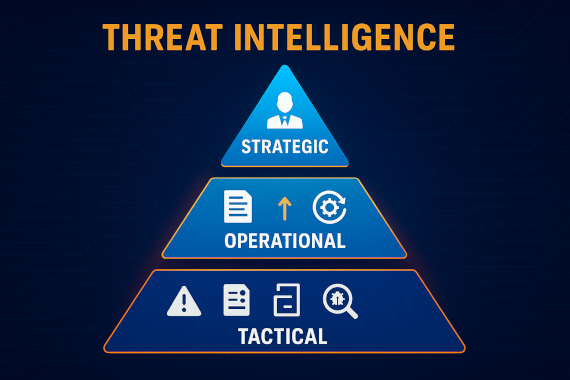
Threat intelligence levels are hierarchical layers of security analysis that range from immediate technical indicators (tactical) through campaign patterns (operational) to long-term business risks (strategic). Each level serves different audiences with different decision-making needs.
Strategic intelligence answers who and why. Attribution, motive, geopolitical context. Long-term focus spanning months to years. Your CISO and board consume this.
Operational intelligence answers how and where. TTPs, campaign analysis, attacker profiles. Medium-term focus spanning weeks to months. Security managers and threat hunters use this.
Tactical intelligence answers what to block right now. IOCs like IP addresses and file hashes. Short-term focus spanning hours to days. SOC analysts and security tools consume this.
Most organizations pick one and run with it. That’s the mistake. Levels are dependencies, not options.
Tactical intelligence without operational context is noise. Operational intelligence without strategic priorities wastes resources. Strategic intelligence without tactical implementation doesn’t stop anything.
What Does Strategic Threat Intelligence Look Like?
Strategic cyber threat intelligence tells executives which business risks to fund.
Here’s an example that actually drives decisions: “Third-party breaches doubled to 30% of all incidents (2025 DBIR). We have 50 critical vendors with privileged access. We only monitor 5. Gap: $216M exposure. Recommendation: $500K for supplier security monitoring.”
That gets budget. Compare that to “We processed 2 million IOCs this quarter.” Nobody writes a check for that.
70% of organizations produce landscape reports (SANS 2025 CTI Survey), but most skip the first step: defining what strategic questions their program should answer.
The fix: Define Priority Intelligence Requirements before subscribing to feeds. Not “collect everything about ransomware.” Instead: “Identify ransomware groups targeting healthcare via VPN exploits. Track ransom payment trends. Provide 48-hour warning capability.”
Strategic direction filters everything downstream. But priorities without operational details are just a wish list. That’s where operational intelligence bridges the gap.
What Does Operational Threat Intelligence Look Like?
Operational cyber threat intelligence bridges strategic priorities and tactical implementation.
Here’s what good operational intelligence looks like: “ALPHV/BlackCat targeting healthcare through Citrix Bleed exploitation. 15 breaches in 30 days. Entry: unpatched Citrix ADC. Lateral movement: Mimikatz credential harvesting. Exfiltration: RClone. Mitigations: patch CVE-2023-4966, enable MFA, deploy RClone detection rule.”
That tells security managers which campaigns are active and what to do about them.
95% of organizations use MITRE ATT&CK (SANS 2024 CTI Survey). It’s primarily an operational-level framework. Technique T1078 (Valid Accounts) shows adversaries using stolen credentials. That operational insight informs strategic planning (invest in credential monitoring) and tactical implementation (deploy detection rules).
SOCs report 60% reduction in attacks when focusing on TTP-level detection versus blocking tactical IOCs alone. TTPs are harder for attackers to change. They rotate infrastructure daily but use the same techniques for months.
What Does Tactical Threat Intelligence Look Like?
Tactical intelligence is the IOCs. Machine-readable data feeding your security tools for automated blocking.
Example: “47 C2 IPs associated with Cl0p targeting healthcare. Block in firewall. Deploy YARA rule YAR-2025-Cl0p-MOVEit. SIEM query attached for RClone detection. IOCs valid 48-72 hours before infrastructure rotation.”
Indicators of Compromise (IOCs) are technical artifacts like IP addresses and file hashes that indicate a system may have been breached. Tactical threat intelligence relies on IOCs for immediate blocking and detection. Most IOCs expire within hours or days as attackers rotate infrastructure.
The tactical trap: organizations subscribe to 15+ threat feeds thinking more data means better security. They collect millions of IOCs. Process them around the clock.
Result: alert fatigue. 2,000+ alerts daily. 56% are false positives. Teams miss real threats buried in noise.
The problem isn’t tactical intelligence itself. It’s tactical intelligence without operational context. Which of those million IOCs actually matter? Which campaigns do they belong to? Which strategic priorities do those campaigns threaten?
What about technical threat intelligence? Some frameworks add a fourth level below tactical. Technical intelligence is the raw data: malicious IPs, file hashes, registry keys. Tactical intelligence is how you use that data defensively. The distinction matters because most organizations collect massive amounts of technical data without the tactical analysis to make it useful.
How Do Strategic, Tactical, and Operational Intelligence Compare?
Here’s how the three levels break down side by side.
| Dimension | Strategic | Operational | Tactical |
|---|---|---|---|
| Question answered | Who’s targeting us and why? | How do attacks work? | What do we block right now? |
| Time horizon | Months to years | Weeks to months | Hours to days |
| Audience | CISO, board, executives | Security managers, threat hunters | SOC analysts, IR teams, security tools |
| Example output | Risk assessment, budget justification | Campaign analysis, TTP breakdown | IOC blocklist, YARA rules, SIEM queries |
| Data volume | Low (handful of trends) | Medium (dozens of campaigns) | High (millions of IOCs daily) |
| Lifespan | Long | Medium | Short (IOCs expire quickly) |
The resource allocation problem: most organizations invest 80% of their CTI budget at the bottom of this table (highest volume, shortest lifespan) and 10% at the top (lowest volume, highest business impact).
The financial pyramid is upside down. According to IBM, organizations with mature CTI programs save $208,087 per breach on average. But only 55% of programs measure effectiveness (SANS 2025 CTI Survey). That measurement gap exists because teams collect data at the bottom without connecting it to the top.
How Do You Integrate the Levels?
You can’t make threat intelligence work without integration. Otherwise you’re paying for data nobody uses.
Most organizations have the pieces. Tactical teams hunt threats. Operational teams write landscape reports. Strategic teams brief executives. But only 21% process intelligence quickly enough to act on it (ASIS International 2025). The pieces don’t talk to each other.
Top-Down Direction (Strategic → Operational → Tactical):
Strategic intelligence sets priorities: what business decisions need intelligence? Operational intelligence filters threats: which campaigns target those priorities? Tactical intelligence implements blocks: which IOCs match those campaigns?
Every tactical IOC should trace back to a strategic priority. If it doesn’t, ask why you’re collecting it.
Bottom-Up Feedback (Tactical → Operational → Strategic):
Tactical detections inform operational patterns. You blocked 47 IPs. All belong to Akira ransomware. Three VPN connection attempts in 48 hours. Pattern: this campaign actively targets you.
Operational patterns update strategic assessments. The Akira detections fit a broader trend of ransomware groups exploiting VPN appliances. Update: third-party VPN vendors are your biggest exposure.
Strategic adjustments drive new tactical collection. New priority: VPN vendor security. New operational focus: VPN exploitation campaigns. New tactical requirement: VPN-targeting malware IOCs.
The loop closes. The threat intelligence lifecycle formalizes this process into six stages, but the core idea is the same: intelligence flows up and direction flows down.
What Integration Looks Like in Practice
Here’s a concrete example of the loop working. Your strategic priority is “reduce ransomware risk to patient data.” That filters your operational focus to ransomware campaigns targeting healthcare. Your operational team identifies that Akira ransomware is exploiting unpatched VPN appliances this quarter. Your tactical team deploys IOCs for known Akira infrastructure and detection rules for their lateral movement techniques.
Two weeks later, your SIEM catches a match. Tactical detection. Your operational team confirms the pattern matches Akira’s playbook. Your strategic team updates the board: “We detected and blocked an active ransomware campaign. Our VPN vendor patching policy needs to be tightened.”
That’s a story the board understands. That’s a program that keeps its funding.
Why 62% of Organizations Fail
62% of organizations cite lack of funding as the top blocker for their CTI program (SANS 2025 CTI Survey), up from 52% the year before. They can’t prove value because they’re not integrating levels.
The organizations that do measure effectiveness closed this loop. They don’t just report activity. They show business impact: we collected tactical IOCs for campaigns targeting strategic priorities. We prevented specific breaches. We informed board decisions about vendor risk. That’s how you survive the next budget cycle.
Where Credential Monitoring Fits
External threat intelligence is one of the fastest ways to close the integration gap. Dark web monitoring gives you tactical data (stolen credentials appearing on criminal markets) that you can act on immediately. But the same data feeds the other levels too.
When employee credentials show up for sale, that’s a tactical indicator: reset the password now. Where they were stolen from (stealer log, third-party breach) tells your operational team what attack method to watch for. How many employees are affected and which systems they access tells your strategic team where the business risk sits. One data point, three levels, connected by your analysis.
Small Organization Advantage
Small teams integrate better. One security team wearing all three hats avoids the silos that kill enterprise programs. You don’t need separate strategic, operational, and tactical teams when the same person reads the DBIR, tracks campaigns targeting your sector, and configures the SIEM rules. That’s an integrated CTI program for under $10,000 annually.
Conclusion
The gap between CTI activity and CTI results comes down to integration. Most programs collect tactical data without connecting it to strategic priorities. They lose funding because they can’t show what the intelligence actually changed.
The fix isn’t more feeds or bigger budgets. It’s closing the loop. Strategic priorities filter operational analysis. Operational analysis drives tactical collection. Tactical detections feed back into strategic updates.
You don’t need a massive budget to make this work. You need the discipline to connect each level to the one above it and the one below it. That’s what separates the 55% who measure effectiveness from everyone else.