Big Data Security Guide: Tools and Best Practices
What Is Big Data Security? If you’re running Hadoop clusters or cloud data lakes, you already know that standard …

Learn what indicators of compromise are, the different types of IOCs, and how to respond when you find them.
• Traditional IOCs are reactive - they tell you what happened after attackers got in. By then, you’re doing forensics, not prevention.
• Monitor for compromised credentials on the dark web alongside your network IOCs - threats often surface externally before attackers breach your systems.
• The Pyramid of Pain framework helps you prioritize IOCs by how difficult they are for attackers to change, with behavioral patterns being most valuable.
• IOCs show what happened; indicators of attack (IOAs) catch attacks in progress. You need both for comprehensive detection.
Your security team probably thinks about indicators of compromise as forensic evidence. Something you find after attackers have already gotten in. That’s only half the story.
The average organization takes 241 days to identify and contain a breach (IBM Cost of Data Breach 2025). That’s eight months of attackers roaming your network, stealing data, and establishing persistence. By the time you find the IOCs, the damage is done.
But here’s what most security teams miss: many IOCs appear outside your network first. Stolen credentials show up on dark web marketplaces. Infostealer logs surface in Telegram channels. Session tokens get leaked before attackers even use them.
We’ll cover the IOC types that matter and how to spot threats before attackers strike.
IOCs work. But they work after the fact. By the time you find a malicious file hash or C2 beacon, attackers have already been inside for weeks or months.
Dark web monitoring and threat intelligence can catch exposed credentials before attackers use them. That’s the shift from reactive forensics to proactive prevention.
Security teams encounter IOCs daily, but many struggle to articulate what separates a genuine indicator from normal network noise.
Indicators of compromise (IOCs) are digital forensic artifacts that suggest a network or system has been breached. NIST defines IOCs as “technical artifacts or observables that suggest an attack is imminent, underway, or has already occurred.” These include file hashes, registry changes, unusual network traffic, and connections to known malicious infrastructure.
Think of IOCs as digital fingerprints left behind by attackers. Just like physical crime scenes have fingerprints, footprints, and DNA evidence, cyber attacks leave traces like unusual login patterns, communication with known malicious servers, or files that match known malware signatures.
The challenge? Attackers know you’re looking for these traces. Threat actors change their infrastructure constantly, modify malware to evade hash-based detection, and use legitimate services to blend in with normal traffic.
This cat-and-mouse dynamic is why IOCs work best as one component of a broader threat intelligence strategy. Relying solely on static IOCs means you’re always one step behind.
Understanding the different types of IOCs helps you build detection capabilities that work together, catching threats that individual indicators might miss.
Not all indicators are created equal. Some IOCs appear instantly when attackers breach your systems. Others take days or weeks to manifest. Knowing what to look for across different categories dramatically improves detection rates.
Network indicators often provide the first evidence of compromise, especially for C2 communication.
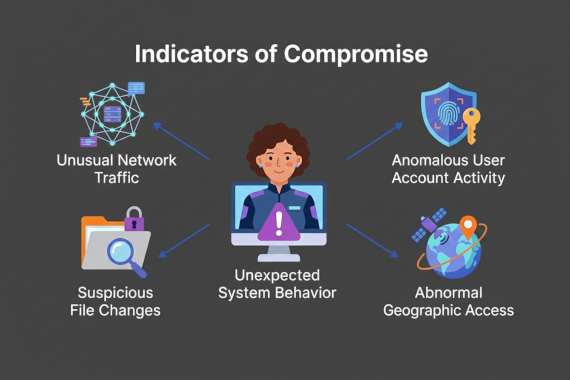
Unusual outbound traffic should raise immediate red flags. Large data transfers at 3 AM usually aren’t scheduled backups. Connections to servers in countries where your business doesn’t operate deserve investigation.
Suspicious DNS requests reveal attacker activity. DNS tunneling, requests to newly registered domains, and communication with known malicious infrastructure all leave traces. Many organizations miss these because they don’t log DNS queries comprehensively.
Geographic anomalies matter too. Impossible travel scenarios, where the same account logs in from two distant locations within minutes, almost always indicate credential theft.
What happens on individual systems tells a different story than network traffic alone.
Registry modifications frequently indicate malware persistence. Attackers love registry run keys for surviving reboots. Unexpected changes to security settings, especially disabling security tools, demand immediate investigation.
Unauthorized software appears regularly in compromised environments. This includes legitimate remote access tools like AnyDesk that attackers deploy after initial access. Just because software is legitimate doesn’t mean its presence is authorized.
Unusual process behavior catches what file scanning misses. PowerShell connecting to external IPs, Office applications spawning cmd.exe, svchost.exe running from unexpected directories. Process monitoring detects memory-only attacks that never drop files to disk.
File indicators remain valuable despite limitations.
Malicious file hashes work well for known threats. MD5, SHA-1, and SHA-256 hashes let you check files against threat intelligence feeds. The catch: attackers modify files constantly, generating new hashes that evade detection.
Suspicious file locations matter as much as the files themselves. Executables in temp folders, DLLs in user directories, scripts where scripts shouldn’t exist. Location context separates legitimate software from threats.
Unexpected encrypted files often indicate ransomware. If files suddenly have new extensions and won’t open, you’re likely dealing with ransomware. Act fast to contain it.
Behavioral indicators catch what static IOCs miss, particularly novel attacks and living-off-the-land techniques (where attackers use legitimate system tools instead of malware).
Failed login attempts spiking across multiple accounts suggests credential stuffing. A single account with many failures might be a forgotten password. Hundreds of accounts with a few failures each? That’s an attack.
Privilege escalation patterns reveal attacker progression. Normal users don’t suddenly need domain admin rights. When accounts move beyond their usual access patterns, something’s wrong.
Database access anomalies deserve special attention. Volume spikes, queries against sensitive tables, exports to unusual destinations are all potential signs of exfiltration.
Knowing what types of IOCs exist is only the first step. Understanding specific examples helps you build practical detection capabilities.
Here are the most critical IOCs security teams encounter, grouped by detection method:
Network indicators: Unusual outbound traffic patterns (large transfers during off-hours, connections to unexpected geographic locations), DNS anomalies (queries to newly registered domains, DNS tunneling patterns), communication with known malicious IPs, and impossible travel scenarios where the same account logs in from distant locations within minutes.
Host indicators: Registry modifications (especially persistence mechanisms like run keys), unauthorized software installations (including legitimate remote access tools deployed by attackers), disabled security tools, new scheduled tasks, and processes running from unexpected locations.
Authentication indicators: Failed login spikes across multiple accounts (credential stuffing), privileged accounts accessing unusual systems, service accounts behaving like users, and administrative activities outside maintenance windows.
Data indicators: Database query volume spikes, exports of sensitive data to portable formats, mass file access to archived data, and compressed files appearing in temp directories (staging for exfiltration).
Detection methods vary by indicator type. Network IOCs require flow analysis and geographic monitoring. Host IOCs need endpoint detection and file integrity monitoring. Authentication IOCs need SIEM correlation.
Understanding these examples helps, but there’s a related concept that completes your detection capabilities.
Security teams often conflate these terms, but the distinction matters for how you structure detection and response.
Indicators of attack (IOAs) identify active attack behavior in real-time, focusing on what attackers are doing rather than what they’ve left behind. While IOCs are forensic evidence of past compromise, IOAs detect attacks in progress by analyzing behavior patterns, technique sequences, and adversary methodologies regardless of specific tools or infrastructure used.
Here’s the practical difference: IOCs tell you what happened. IOAs tell you what’s happening right now.
An IOC might be a specific malware hash. An IOA would be “PowerShell executing encoded commands downloaded from the internet,” which catches the technique regardless of the specific malware variant.
IOCs are reactive. You need threat intelligence telling you a specific hash or IP is malicious. If attackers use new infrastructure, IOC-based detection fails until someone identifies and shares that new indicator.
IOAs are proactive. They detect attack patterns rather than specific artifacts. Lateral movement looks similar whether attackers use Mimikatz, Rubeus, or a custom tool. Behavioral detection catches all three.
IOCs are easier to implement. Block this IP. Alert on this hash. Match this domain pattern. The logic is straightforward.
IOAs require more sophisticated detection. You need to understand normal behavior to identify abnormal behavior. False positive tuning takes significant effort.
The best security programs use both. IOCs catch known threats quickly. IOAs catch novel threats and attacks using legitimate tools. Neither approach works well alone.
86% of organizations now use the MITRE ATT&CK framework (SANS 2025 CTI Survey), which maps both IOCs and IOAs to specific adversary techniques. This gives you a common language for describing threats and helps you build better detection.
Once you understand what to look for, the next question is how to find it.
Detection requires both the right tools and the right processes.
SIEM platforms aggregate logs and apply detection rules. They’re essential for correlating events that individually look benign but together indicate compromise.
EDR/XDR solutions provide endpoint visibility that network monitoring can’t match. Modern platforms detect behavioral IOCs, not just file signatures.
Threat intelligence platforms turn raw IOC feeds into actionable detection rules, normalizing indicators from multiple sources and adding context about threat actors.
Network monitoring tools catch IOCs that endpoint solutions miss, particularly for unmanaged devices and lateral movement.
IOCs tell you what already happened. These approaches help you catch attacks before they happen.
Dark web monitoring for leaked credentials surfaces compromised passwords before attackers can use them. One in three attacks now use valid credentials as the initial access vector (IBM X-Force 2025).
Infostealer channel monitoring tracks marketplaces where malware operators sell stolen data. These logs contain session tokens and browser data that enable MFA bypass. Monitoring infostealer channels catches credential theft even when your security tools missed the initial infection.
Threat actor communication tracking monitors forums and Telegram channels where attackers sell stolen data and access. If your company’s data shows up, you’ll know.
David Bianco’s Pyramid of Pain prioritizes IOC types by how much they hurt attackers when blocked.
At the base: hash values (trivial to change) and IP addresses/domains (attackers maintain large infrastructure pools). These provide minimal adversary friction.
In the middle: network and host artifacts like user agents, file paths, and registry keys. Changing these requires attackers to modify tools, not just swap servers.
At the top: TTPs (tactics, techniques, and procedures). Detecting behavioral patterns forces attackers to completely change their approach. This is maximum pain.
The lesson? Invest more in behavioral detection than static indicators. Hash blocklists help, but detecting attacker behavior provides longer protection.
IOCs are valuable but imperfect. Understanding their limitations prevents overconfidence.
Strengths: IOCs provide concrete, shareable evidence. They enable automation at scale and integrate easily across security tools. They support threat intelligence sharing and provide historical context for investigations.
Limitations: Static IOCs have short lifespans. Change one byte of a file and you have a new hash. Malware authors automate this, generating unique variants for every target. IP addresses and domains change constantly. False positives create alert fatigue.
Context matters. An IP flagged as malicious might host hundreds of legitimate sites (shared hosting).
IOCs alone aren’t enough. The most effective security programs combine static IOCs for known threats, behavioral detection for novel attacks, threat intelligence for adversary context, and dark web monitoring for proactive credential compromise detection.
When you find IOCs, how fast you respond determines how much damage attackers can do.
Finding IOCs is only valuable if you act on them effectively. The gap between detection and response determines outcomes.
Incident response activation should happen immediately when high-confidence IOCs appear. Don’t wait for certainty. If you see an active C2 beacon, treat it as confirmed compromise until proven otherwise.
System isolation prevents lateral movement. Disconnect compromised systems without powering them off (preserving forensic evidence). Contain the blast radius while you investigate.
Forensic investigation determines scope. Which systems were accessed? What data was touched? How did attackers get in? This informs both immediate response and long-term remediation.
Credential reset is often overlooked. If attackers had access, assume they harvested credentials. Reset passwords for accounts that touched compromised systems. Check if those credentials have been leaked to the dark web - if so, the breach may be wider than you think.
Post-incident IOC sharing helps the broader community. Organizations like ISACs facilitate threat intelligence sharing within industries. The 77% of organizations using CTI for threat hunting (SANS 2025 CTI Survey) are actively looking for IOCs rather than waiting for alerts.
Indicators of compromise remain fundamental to security operations, but the paradigm is shifting. Traditional IOC detection waits for attackers to reach your network. Proactive approaches find compromise before exploitation.
The numbers tell the story. Organizations take an average of 241 days to identify and contain breaches. One in three attacks use valid credentials. Infostealer delivery is up 84%. Waiting for network and host IOCs to appear means accepting months of attacker access.
Dark web monitoring changes this equation. When your employees’ credentials appear on criminal marketplaces, you know immediately. When infostealer logs containing session tokens surface, you can invalidate them before attackers use them.
The most effective security programs combine reactive IOC detection with proactive threat intelligence. They monitor both their networks and the criminal underground where attacks originate.
Ready to shift from reactive to proactive? Check your organization’s dark web exposure to find out what attackers might already know about you.
Common IOC examples include unusual outbound network traffic, DNS requests to malicious domains, and failed login spikes. You’ll also see unexpected registry changes, suspicious file hashes, and geographic access anomalies. Each indicator type needs different detection methods.
IOCs reduce breach detection time from months to hours. Without them, attackers operate undetected while stealing your data. The median dwell time is 11 days for organizations with detection capabilities. IOCs also enable threat intelligence sharing between organizations. This helps entire industries defend against common adversaries.
IOCs have significant limitations you should understand. Hash-based IOCs become useless when attackers modify a single byte of malware. IP addresses and domains change constantly. The Pyramid of Pain framework shows basic IOCs are easiest to evade. Behavioral IOCs and TTPs are most reliable. They require attackers to completely change their methods.
The four main cyber threat types are malware (ransomware, trojans, spyware), social engineering (phishing, business email compromise), insider threats (malicious or negligent employees), and advanced persistent threats (nation-state actors running long-term campaigns). Each threat type produces different indicators of compromise you can detect.
Zero-day exploits target vulnerabilities unknown to the software vendor. No patch exists yet. Traditional IOCs struggle with zero-days because there’s no prior malware signature. Behavioral IOCs become critical here. Even novel exploits produce detectable patterns like unusual process execution or anomalous network connections.
The three most common IOCs are unusual network traffic patterns (outbound connections to unknown destinations), authentication anomalies (failed logins, impossible travel, privilege escalation), and file-based indicators (suspicious hashes, unexpected executables). These appear across most breach types. You’ll find them regardless of attacker sophistication.
What Is Big Data Security? If you’re running Hadoop clusters or cloud data lakes, you already know that standard …

Email Security Credential Theft
What Is BEC? Business Email Compromise (BEC) is a type of cyber attack where an attacker gains access to a corporate …