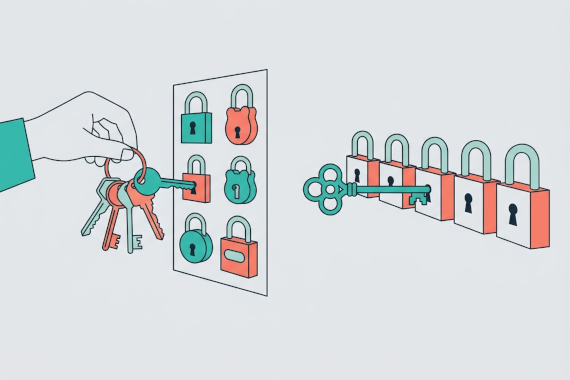
Credential Stuffing vs. Password Spraying
Learn the difference between credential stuffing and password spraying so you can defend against both.
• Credential stuffing exploits password reuse. If your employees use the same password on personal and work accounts, one breach anywhere puts your systems at risk.
• Password spraying stays below lockout thresholds on purpose. Each account only sees one or two failed logins, so per-account alerts won’t catch it. You need to watch for patterns across your entire directory.
• Password spraying bypasses traditional complexity rules. “Summer2026!” meets most password policies but appears on every common password list. You need blocklists, not just complexity requirements.
• Credential monitoring catches stuffing early. Password blocklists and MFA stop spraying. You need both.
Both attacks target login pages. Both can compromise thousands of accounts. But they work in completely different ways, and defending against one doesn’t protect you from the other.
Credential stuffing relies on stolen passwords from previous breaches. Password spraying relies on people choosing weak passwords. The source of the password is what separates them.
If you’re seeing unusual login activity, the failed login patterns tell you which attack you’re dealing with and what to do about it.
This guide breaks down how each attack works, how to tell them apart, and how to defend against both.
What Is Credential Stuffing?
Credential stuffing is one of the most common account takeover methods. You’ve probably seen it referenced in breach reports without recognizing it.
Credential stuffing is an automated attack where criminals take username and password pairs stolen from one data breach and test them against other websites. It works because most people reuse passwords. A breach at one site gives attackers a key to every other site where that password was used.
Here’s the basic flow. A breach happens and millions of credentials leak. Those credentials end up on dark web combo lists or get extracted from stealer logs. Attackers buy or download these lists. Then they feed the credentials into automated tools that test them against login pages at scale.
The success rate is low, usually around 0.1% to 2%. But when you’re testing millions of credential pairs, even 0.1% yields thousands of compromised accounts. That’s what makes credential stuffing so effective. Volume makes up for the low hit rate. OWASP’s credential stuffing documentation covers the technical classification in more detail.
According to Verizon’s 2025 Data Breach Investigations Report, stolen credentials are involved in the vast majority of basic web application attacks. Most of those credentials came from third-party breaches and stealer logs.
What makes credential stuffing dangerous isn’t the technique. It’s the sheer volume of available credentials. Billions of username and password pairs are circulating on criminal marketplaces right now. New breaches add millions more every month. As long as people reuse passwords, attackers will keep running these attacks because they’re cheap and effective.
What Is Password Spraying?
Password spraying takes the opposite approach. Instead of using stolen passwords, attackers guess common ones.
Password spraying is an attack where criminals try a small number of commonly used passwords against a large number of accounts. Instead of targeting one account with many guesses, they target many accounts with one guess. This avoids triggering account lockouts while still finding accounts with guessable passwords.
A password spraying attack looks like this:
- Username: sally@company.com → Password: Summer2026!
- Username: bob@company.com → Password: Summer2026!
- Username: jill@company.com → Password: Summer2026!
- Username: peter@company.com → Password: Summer2026!
The attacker tries one common password across every account. If none of them work, they wait an hour and try the next one: “Password123!”, then “Welcome1!”. They keep rotating through common passwords until one hits. They only need one person with a weak password to get in.
Password spraying is slower than credential stuffing. But it’s stealthier. Each account only sees one or two failed login attempts, which stays well below most lockout thresholds.
Attackers often research their targets before spraying. They’ll scrape employee email addresses from LinkedIn or company websites to build a username list. They also tailor their password guesses to the target. A company called “Acme” might see attempts with “Acme2026!” or “AcmePassword1”. Seasonal passwords are popular too, like “Winter2025!” or “Spring2026!”.
Password spraying is especially effective against login pages without rate limiting or password blocklists. VPN portals and legacy Active Directory environments are common targets because they often lack these protections.
How Do Credential Stuffing and Password Spraying Differ?
Both attacks target login pages, but they come from different angles. Here’s how they compare:
Source of passwords. Credential stuffing uses real passwords stolen from breaches. The attacker knows these passwords actually worked at some point. Password spraying uses guessed passwords from common password lists.
What it exploits. Credential stuffing exploits password reuse. If your employees use the same password on LinkedIn and your company VPN, a LinkedIn breach puts your network at risk. Password spraying exploits predictable password choices. People pick passwords like “Summer2026!” or “CompanyName1” that feel secure but show up on every attacker’s list.
Success rate. Credential stuffing has a higher success rate because the passwords are real. Password spraying relies on the odds that at least one person out of thousands chose something guessable.
Detection signals. Credential stuffing generates plenty of failed logins too (98%+ of attempts fail), but the successful ones look like normal logins from unusual locations. That’s what makes it dangerous. Password spraying is easier to detect because you’ll see many accounts failing with the same password.
Speed. Credential stuffing can test millions of credentials in hours. Password spraying is deliberately slow. Attackers space out attempts to avoid detection and lockouts.
Target selection. Credential stuffing is opportunistic. Attackers don’t care which company they hit. They test stolen credentials against every login page they can find. Password spraying is more targeted. Attackers typically pick a specific company and enumerate usernames through email formats or directory services.
How Do You Detect Each Attack?
Here’s what to look for in your logs and SIEM alerts.
Credential Stuffing Detection
Watch for successful logins from unusual locations. Since the attacker has the correct password, they often get in without triggering failed login alerts. Look for:
- Logins from IP addresses your employees have never used before
- Impossible travel patterns (a user logging in from two countries within minutes)
- Sudden spikes in login volume, especially outside business hours
- Multiple accounts accessed from the same IP address in quick succession
The best way to get ahead of credential stuffing is credential monitoring. If you know which of your employees’ passwords have been exposed in breaches, you can reset them before attackers test them.
Password Spraying Detection
Password spraying leaves different fingerprints. Since the passwords are guessed, most attempts fail. Look for:
- Many accounts experiencing one or two failed logins within the same time window
- The same password being rejected across multiple accounts
- Failed login attempts that follow alphabetical or sequential username patterns
- Login attempts distributed across many IP addresses to avoid rate limiting
Most SIEM tools can correlate these signals if you set up the right detection rules. The key is looking at patterns across accounts, not just individual account activity.
One common mistake is setting detection thresholds per account. An attacker spraying one password per account per day won’t trigger a “5 failed attempts” alert on any single account. You need to aggregate failed logins across your entire user base and look for coordinated patterns.
How Do You Defend Against Both?
A few defenses work against both attacks. Others are specific to one or the other.
MFA stops both. Multi-factor authentication is the single most effective defense. Even if attackers have the right password (stuffing) or guess it correctly (spraying), they can’t get past the second factor. Roll it out to every account, starting with admin and privileged access.
Credential monitoring stops stuffing. Dark web monitoring services scan for your employees’ credentials in breach data and stealer logs. When exposed credentials are found, you can force a password reset before attackers use them. If the stolen password has already been reset, the attack won’t succeed.
Password blocklists stop spraying. Traditional complexity rules (uppercase, number, special character) don’t help. “Summer2026!” meets every complexity requirement but this style password appears on every common password list. Follow NIST 800-63B guidelines: check new passwords against known compromised and commonly used password lists. Block passwords that appear on these lists regardless of complexity.
Rate limiting and CAPTCHA help with both. Slow down automated login attempts with rate limiting. Add CAPTCHA challenges after failed attempts. These won’t stop a determined attacker, but they raise the cost of running attacks at scale.
Account lockout policies need tuning. Standard lockout policies (lock after 5 failed attempts) stop brute force attacks but don’t stop password spraying. Spraying attacks stay below the threshold by design. Consider time-based lockouts that factor in failed login patterns across all accounts, not just individual ones.
Password managers help with both. Unique passwords stop credential stuffing from spreading across sites. Random passwords aren’t guessable, so password spraying fails too. But if a stealer log captures the password for a specific app, a unique password won’t save you. You still need credential monitoring and MFA.
For a deeper look at credential stuffing defenses specifically, see our guide on credential stuffing prevention.
Conclusion
Credential stuffing and password spraying both hit your login page, but the fix for one doesn’t cover the other. MFA is the closest thing to a single solution since it blocks both. Beyond that, credential monitoring handles the stuffing side by catching exposed passwords early. Password blocklists handle the spraying side by rejecting the predictable passwords that attackers try first.
Want to see which of your employees’ credentials are already exposed? Run a free dark web scan or book a demo to see Breachsense in action.