Data Leakage Prevention: 14 Strategies for Security Teams
Data Leak Prevention Data Security Best Practices
What Is Data Leakage Prevention? Your sensitive data could be leaking right now through a misconfigured cloud bucket, a …

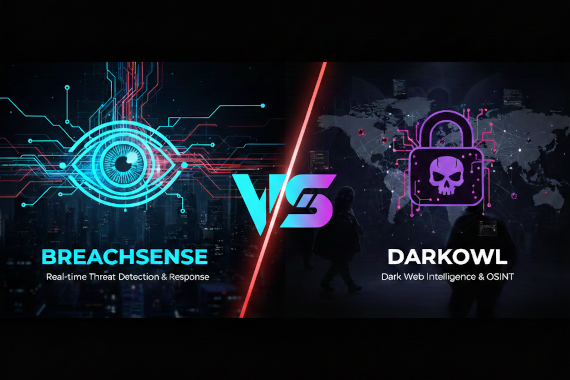
Learn which dark web monitoring platform fits your security team’s workflow.
• DarkOwl provides raw darknet data access through APIs and a search interface for threat research
• Breachsense monitors for your specific credentials and data, then alerts you when threats appear
• DarkOwl is made for researchers and analysts who want to explore darknet content
• Breachsense is made for security teams who need automated detection and response workflows
DarkOwl and Breachsense both monitor the dark web. But they’re built for different use cases and buyers.
DarkOwl is a data platform. It gives you access to a massive archive of darknet content through APIs and a search interface. You get raw data. What you do with it is up to you.
Breachsense is designed for detection and response. It monitors for your credentials and data, then alerts you when something appears. Less raw data access, more actionable intelligence.
This comparison breaks down how each platform works so you can pick the right fit for your security program.
DarkOwl is a darknet data platform. They collect content from across the dark web and make it searchable through their Vision UI interface and APIs.
The company claims to have “the world’s largest index of darknet content” according to their product documentation. Their archive goes back 5+ years.
Darknet intelligence (DARKINT) is the collection and analysis of data from dark web sources like Tor hidden services and criminal forums. Unlike surface web intelligence, DARKINT requires tools like Tor to access networks that aren’t indexed by regular search engines.
DarkOwl’s primary audience is threat researchers and intelligence analysts. Law enforcement and national security agencies are among their customers. It’s designed for exploration and investigation rather than automated monitoring.
Massive data archive. DarkOwl maintains one of the largest commercial darknet databases. They collect from Tor, I2P, Telegram, paste sites, and criminal forums. The 5+ year historical archive is valuable for forensic investigations.
Powerful search interface. Vision UI supports Boolean and regex queries. You can filter by network or entity type. It supports 47 languages with natural language processing for categorization.
Research-focused tools. DarkOwl includes features like “Direct to Darknet” that lets analysts safely jump from search results to the actual dark web for further investigation. They maintain a DARKINT Lexicon for identifying marketplaces and criminal groups.
Data licensing model. DarkOwl offers data feeds and API access for organizations that want to build their own products on top of darknet data. This appeals to threat intelligence vendors and data providers.
Market monitoring. Their DarkMart database tracks 81 darknet marketplaces with over 387,000 listings and 16,000 vendors according to their Q4 2025 product updates. You can analyze market trends and vendor activity.
Breachsense monitors for your specific credentials and data across dark web sources. When your employee passwords or company data appear in stealer logs or breach dumps, you get an alert.
Breachsense is designed for security operations. You configure what to monitor. It watches continuously. When something matches, you get notified with enough context to act.
Credential monitoring is the automated detection of stolen usernames and passwords across dark web sources. When employee credentials appear in stealer logs or third-party breaches, monitoring platforms alert security teams so they can force password resets before attackers exploit the credentials.
Breachsense monitors Telegram channels where stolen credentials from infostealers like RedLine and Vidar appear. It tracks ransomware gang leak sites and indexes the files attackers publish. It also monitors criminal forums and paste sites for your company data.
Automated credential detection. Configure your domains and Breachsense watches for exposed credentials continuously. When your employees’ passwords appear in stealer logs or breach data, you get an alert. No manual searching required.
Full-text search on leaked files. Breachsense indexes documents from ransomware attacks. Search for your company name in leaked files, not just credentials. If a vendor gets breached and your contracts are in that dump, you can find them.
Real-time alerting. Webhooks push notifications to your existing security tools. Build automated response workflows that trigger password resets or incident tickets when credentials are detected.
API-first architecture. Breachsense was built for integration. The REST API lets you query breach data programmatically. Teams building products that embed credential intelligence use Breachsense as their data layer.
Password cracking. Hashed passwords are cracked to plaintext so you know exactly which credentials are compromised. You can verify if the exposed password matches what’s currently in use.
Session token detection. Beyond passwords, Breachsense detects session tokens and cookies from stealer logs. Session tokens let attackers bypass MFA entirely.
DarkOwl gives you a massive data archive to explore. Breachsense monitors for your specific data and alerts you when it appears. Different tools for different jobs.
| Capability | DarkOwl | Breachsense |
|---|---|---|
| Time to value | Requires analyst setup | Turnkey monitoring |
| Credential monitoring | Manual search | Automated alerts |
| Stealer log coverage | ✓ | ✓ |
| Full-text document search | Limited | ✓ |
| API access | ✓ | ✓ (API-first) |
| Real-time alerting | Manual setup | Built-in webhooks |
| Threat research tools | ✓ | Limited |
| Primary use case | Research & investigation | Detection & response |
This is the core difference between the platforms.
DarkOwl gives you access to a darknet data archive. You search it. You explore it. You build queries to find what you’re looking for. It assumes you have analysts who know what to look for and time to hunt through data.
Breachsense monitors for specific threats. You tell it what domains to watch. It alerts you when credentials or data appear. It assumes you want detection without manual hunting.
For organizations with dedicated threat intelligence teams, DarkOwl’s exploration model provides flexibility. For security teams that need automated monitoring alongside their other responsibilities, Breachsense fits better.
DarkOwl assumes you have analysts who will search data and build queries. Their customers include law enforcement and national security agencies.
Breachsense assumes you want to detect credential exposures and respond quickly. Configure your domains, get alerts when threats appear, integrate with your existing response workflows.
DarkOwl excels at threat research. Vision UI supports complex queries with Boolean logic and regex. The 5+ year historical archive is useful for forensic investigations. Features like Direct to Darknet let analysts pivot from search results to live dark web content.
Breachsense isn’t designed for open-ended research. It monitors your specific assets and alerts you to exposures. It answers “is my data exposed?” rather than “what’s happening on the dark web?”
If your security program includes dedicated threat research, DarkOwl provides the tools for it. If you need to detect credential exposures without building a research capability, Breachsense handles that.
DarkOwl offers APIs for data access. But the primary experience is Vision UI, a web interface for searching and exploring data. If you want automated workflows, you’ll need to build that infrastructure yourself.
Breachsense was built API-first. Webhook alerts integrate directly with your SIEM or ticketing system. It’s made for teams who want credential detection feeding into existing response workflows.
DarkOwl fits best when:
You have a dedicated threat intelligence team. DarkOwl requires analysts who can search data and build queries. If you have people whose job is darknet research, DarkOwl gives them powerful tools.
You need to explore darknet content broadly. DarkOwl indexes Tor pages and forums - not just credentials. If you’re tracking what’s being discussed, not just what’s leaked, DarkOwl covers that.
You’re tracking criminal groups or marketplace activity. DarkOwl’s DarkMart database monitors vendor activity across marketplaces. Their tools are designed for tracking actors, not just defending your assets.
Your organization invests in threat intelligence. DarkOwl serves organizations that treat threat intelligence as a core capability. If you have the team to use a full darknet data archive, DarkOwl provides it.
Research flexibility matters more than automated alerts. DarkOwl lets you explore broadly. If you don’t know exactly what you’re looking for, the exploration model helps.
Breachsense fits best when:
You need automated credential monitoring. Configure your domains and Breachsense watches for exposed credentials. No manual searching. When your employees’ passwords appear in stealer logs, you get an alert.
You want alerts that integrate with existing workflows. Breachsense’s webhooks and API let you pipe credential alerts into your SIEM or ticketing system. Build automated response workflows that trigger password resets.
You need to search leaked documents. Breachsense indexes files from ransomware attacks. If a vendor gets breached and your data is in those files, you can search for it. This matters for third-party risk monitoring.
You’re monitoring for specific exposures, not doing open research. Breachsense answers “is my data exposed?” efficiently. If that’s your primary question, you don’t need a research platform.
Your security team needs to focus on response, not research. Breachsense automates detection so your team can focus on acting on alerts rather than hunting through data. If your team doesn’t have dedicated time for darknet research, automated monitoring fits better.
Some organizations use DarkOwl for research and Breachsense for automated monitoring. The platforms serve different purposes, so there’s less overlap than you might expect.
DarkOwl gives you exploration capabilities for threat research and investigations. Breachsense provides automated detection for your specific assets. If you need both capabilities, they complement each other.
Having said that, for most organizations, one platform is sufficient.
Beyond DarkOwl and Breachsense, here’s a framework for evaluating any dark web monitoring vendor:
Start by clarifying what you need:
The answers determine whether you need a data platform or a detection platform.
Ask vendors specifically what they monitor:
Understand how the platform fits your stack:
If you’re building automated workflows, API-first platforms save development time.
Confirm the platform matches your team:
The right platform depends on how your team actually works, not just feature lists.
DarkOwl and Breachsense serve different purposes despite both monitoring the dark web.
Choose DarkOwl if you have a dedicated threat intelligence team that needs to explore darknet data.
Choose Breachsense if you need automated monitoring that alerts you when your credentials appear.
Most security teams need detection more than exploration. If you want to know when your credentials are exposed without manually hunting through darknet data, Breachsense fits that use case.
Want to see what’s exposed? Check your dark web exposure or book a demo to see how Breachsense’s automated monitoring works.
DarkOwl is a darknet data platform. You search and explore their dark web archive directly. Breachsense is a detection platform that monitors for your specific credentials and data, then sends alerts when threats appear. DarkOwl requires analysts to hunt through data. Breachsense automates the monitoring.
It depends on your team’s resources. DarkOwl requires analysts who can search data and build their own workflows. Breachsense provides automated credential monitoring with alerts you can act on directly. If you have a dedicated threat intelligence team, DarkOwl gives more flexibility. If you need turnkey monitoring, Breachsense fits better.
DarkOwl is a data exploration platform. You search their archive and build your own workflows. Breachsense is a detection platform. You configure what to monitor and get alerts when threats appear. The right choice depends on whether you need research capabilities or automated monitoring.
DarkOwl collects credential data as part of its broader darknet archive. But it’s designed for data exploration rather than automated credential monitoring. Breachsense specifically monitors your domains for exposed credentials and sends real-time alerts when they appear.
Breachsense indexes files from ransomware attacks and lets you search for your company name in leaked documents. If a vendor gets breached and your contracts are in that dump, you can find them. DarkOwl focuses more on darknet content broadly rather than full-text document search.
Yes. Breachsense was built API-first with a full REST API and webhook support. You can pipe alerts directly into your SIEM or ticketing system. DarkOwl also offers APIs, but their platform is more oriented toward data exploration than automated workflows.
Data Leak Prevention Data Security Best Practices
What Is Data Leakage Prevention? Your sensitive data could be leaking right now through a misconfigured cloud bucket, a …

Dark Web Monitoring Threat Intelligence Credential Monitoring Security Research
What Is a Dark Web Market? When your credentials get stolen, they often end up for sale on a dark web market within …