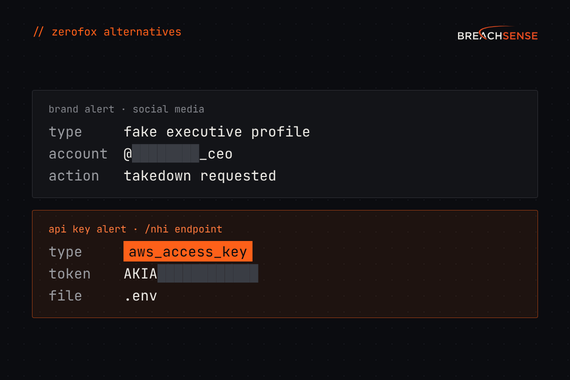
ZeroFox Alternatives & Competitors (2026)
Quick Summary
The best ZeroFox alternatives are Breachsense, Recorded Future, Flare and DarkOwl. Pick Breachsense for leaked credentials and searching inside leaked files, Recorded Future for nation-state intelligence, Flare for checking whether leaked passwords still work, or DarkOwl for raw darknet data.
| Tool | Best for | Rating |
|---|---|---|
| Breachsense | Teams that want leaked credentials, including passwords typed into phishing pages, plus leaked API keys and full-text search of leaked files, through an API | 4.8/5 (G2) |
| Recorded Future | Large teams with threat intelligence analysts who need geopolitical and nation-state coverage | 4.5/5 (G2) |
| Flare | Teams that want to check whether leaked passwords still work in Microsoft Entra ID or Okta, then revoke sessions or disable the account | 4.7/5 (Gartner Peer Insights) |
| DarkOwl | Investigators who want to search raw darknet data, including an archive going back 8+ years | Not enough reviews (G2) |
ZeroFox Covers Brand, Social Media and the Dark Web
ZeroFox is best known for brand and social media protection.
ZeroFox is a broad digital risk protection platform. It covers brand abuse, social media impersonation, and executive protection alongside dark web monitoring. That sheer breadth is the main draw for teams defending a public brand across social media and the open web.
But breadth comes with trade-offs. Teams that need leaked API keys, passwords typed into phishing pages or full-text search across leaked files often find a focused platform fits better.
If you’re weighing ZeroFox competitors, this page breaks down where ZeroFox is strong, where Breachsense covers what ZeroFox misses, and how the other main alternatives compare.
Last reviewed October 15, 2026. Facts about ZeroFox come from zerofox.com, and ratings from G2 and Gartner Peer Insights.
What Does ZeroFox Do Well?
ZeroFox calls itself an external cybersecurity platform, built for breadth. It monitors external threats across social media, the open web, and the dark web. ZeroFox also removes malicious content through takedown services.
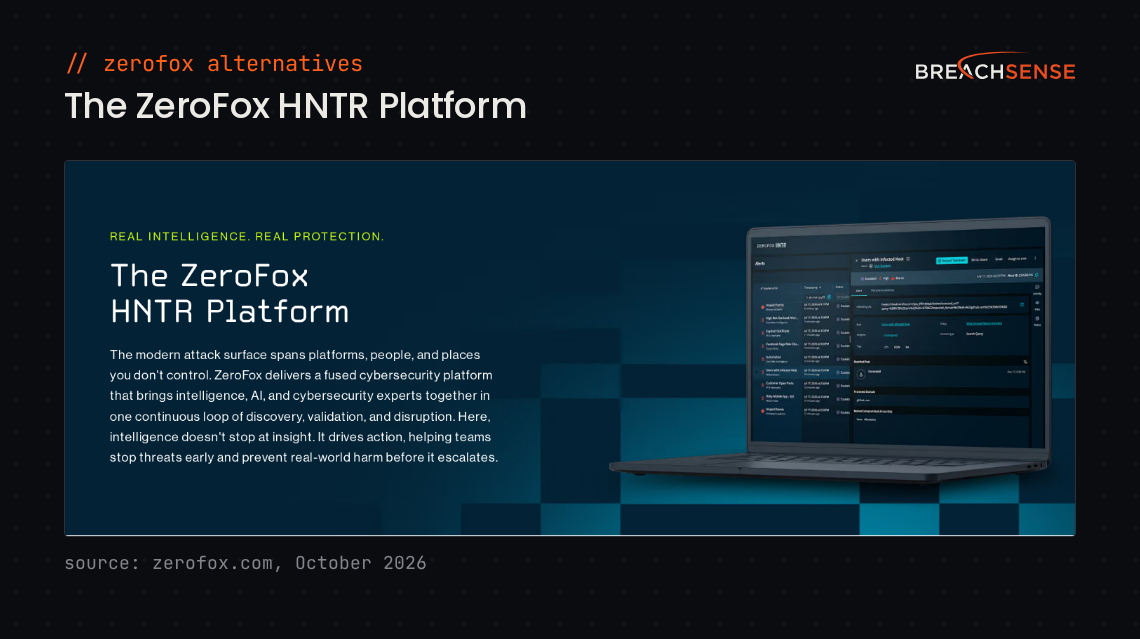
ZeroFox went public in 2022, then was taken private by Haveli Investments in 2024 and delisted from Nasdaq. It expanded through acquisitions including Vigilante for dark web intelligence and LookingGlass for attack surface management. Its platform covers several threat categories:
- Brand protection against counterfeit listings and brand abuse
- Social media monitoring for impersonation and targeted attacks
- Executive protection against deepfakes and online-to-physical threats
- Domain protection to identify lookalike domains used for phishing
- Dark web monitoring for exposed credentials and data leaks
Their primary strength is social media coverage. ZeroFox’s in-house team takes down threats such as phishing domains and fake social media accounts. While each takedown completes, ZeroFox’s Global Disruption Network blocks the threat across 80+ partners.
If you want brand, social media and dark web coverage in one platform, ZeroFox is a good fit.
Why Do Teams Look for ZeroFox Alternatives?
Teams look for ZeroFox alternatives when they need leaked API keys, passwords typed into phishing pages or full-text search of leaked files. ZeroFox’s G2 reviews also cite false positives and slow takedowns.
You Need Leaked API Keys and Phished Passwords
Stolen credentials remain one of the most common ways attackers get in.
A stealer log is the bundle of data that infostealer malware harvests from an infected device, including saved browser passwords and session cookies. Criminals sell or dump these logs on Telegram channels and forums. A single infected device can expose dozens of your corporate logins at once.
ZeroFox says it indexes “5k+ new stealer logs” a day. ZeroFox’s site doesn’t list leaked API keys, or passwords employees typed into phishing pages. Breachsense alerts on both, and finds API keys in stealer logs.
You Need Full-Text Search Across Leaked Documents
When a vendor gets hit with ransomware, attackers grab contracts and financial records, not passwords alone. ZeroFox detects data leaks and alerts you when your organization’s data surfaces. ZeroFox’s site doesn’t describe searching inside leaked files.
That matters for third-party risk monitoring. If a law firm that handles your contracts gets breached and the group dumps the files, you want to search that dump for your company name. Knowing the law firm was breached doesn’t tell you which of your data was in the files.
ZeroFox Sends False Positives, and Some Takedowns Take Weeks
On G2, ZeroFox users report false positives, duplicate alerts, and takedowns that stay open for weeks or fail. ZeroFox has analysts review detections to cut false positives, but these G2 users still report them.
How Does Breachsense Compare to ZeroFox?
Breachsense focuses on credentials and leaked files rather than broad brand coverage. Both monitor stealer logs, session tokens, criminal forums and ransomware leak sites.
| Capability | ZeroFox | Breachsense |
|---|---|---|
| Credential monitoring | Yes | Yes |
| Stealer log coverage | Yes | Yes |
| Session token detection | Yes | Yes |
| Criminal forum monitoring | Yes | Yes |
| Social media monitoring | Yes | No |
| Brand and executive protection | Yes | No |
| Takedown services | Yes | Phishing and lookalike domains |
| Leaked password returned | Yes, through ZeroFox’s API | Yes, with password hashes cracked where possible |
| Leaked API keys and OAuth tokens | Not listed on zerofox.com | Yes |
| Passwords typed into phishing pages | Not listed on zerofox.com | Yes |
| Search inside leaked files | Not described on zerofox.com | Yes, full text |
| How findings reach you | Platform, REST APIs, webhooks, syslog | REST API, JSON webhooks, email |
| G2 rating, October 2026 | 4.4/5 | 4.8/5 |
For a detailed feature-by-feature comparison, see Breachsense vs ZeroFox.
Who Should Choose ZeroFox, and Who Should Choose Breachsense?
There are teams ZeroFox serves better.
Brand and social media are your main risk. ZeroFox covers impersonation across social platforms at a scale we don’t attempt.
You need takedowns beyond domains. We take down phishing and lookalike domains. ZeroFox also removes counterfeit listings and fraudulent apps.
You need an executive-ready report. Our API returns JSON.
You need executive protection. ZeroFox removes fake profiles and deepfakes of executives.
Breachsense serves these teams better.
Document search. Breachsense indexes files leaked by 100+ ransomware groups, plus files from third-party breaches and unsecured databases. You can run full-text searches for your company name or domain in the leaked content. ZeroFox’s site doesn’t describe searching inside leaked files.
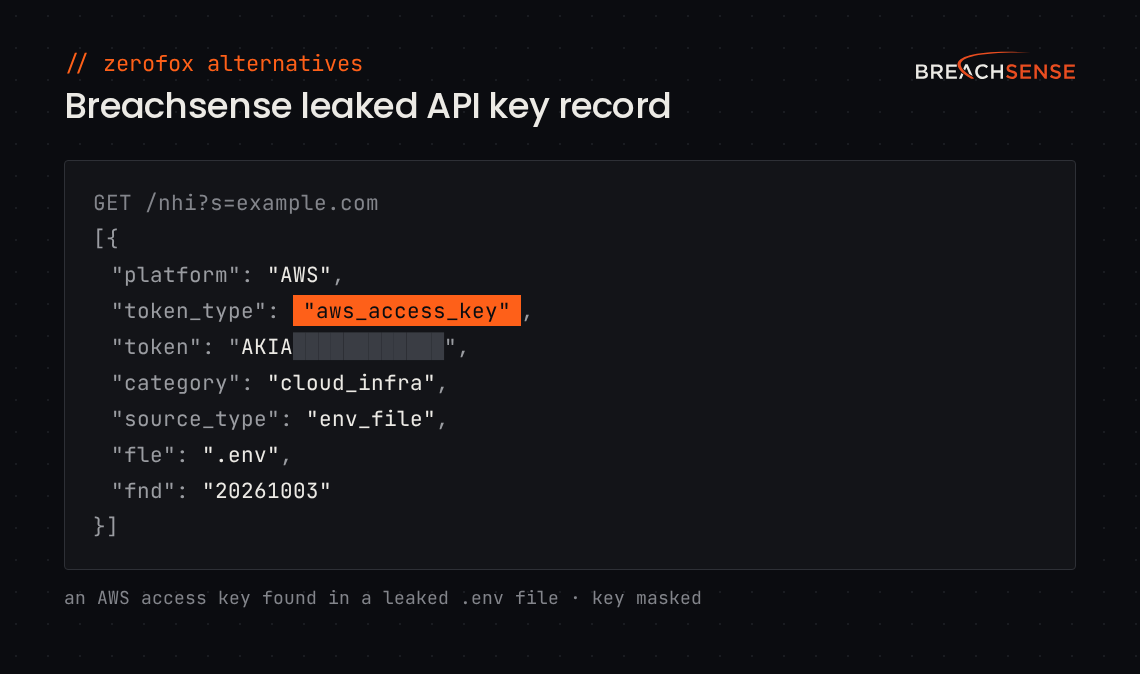
Leaked API keys. Breachsense returns machine credentials that ZeroFox doesn’t list, such as API keys and OAuth tokens from infected employee devices. Those non-human identities often open more doors than a single user password does.
Phished passwords. Breachsense alerts you when an employee’s password is typed into a phishing page, so you can reset it even after the page is taken down.
API-first design. Breachsense was built for programmatic access from day one. The REST API and webhooks let you pipe alerts into your SIEM or build custom workflows, with integration in hours.
See ZeroFox vs Breachsense for dark web monitoring for a closer look.
What Other ZeroFox Competitors and Alternatives Exist?
ZeroFox is one option among several. For a broader category view, see our best dark web monitoring tools roundup. Here are the main alternatives teams evaluate.
Recorded Future
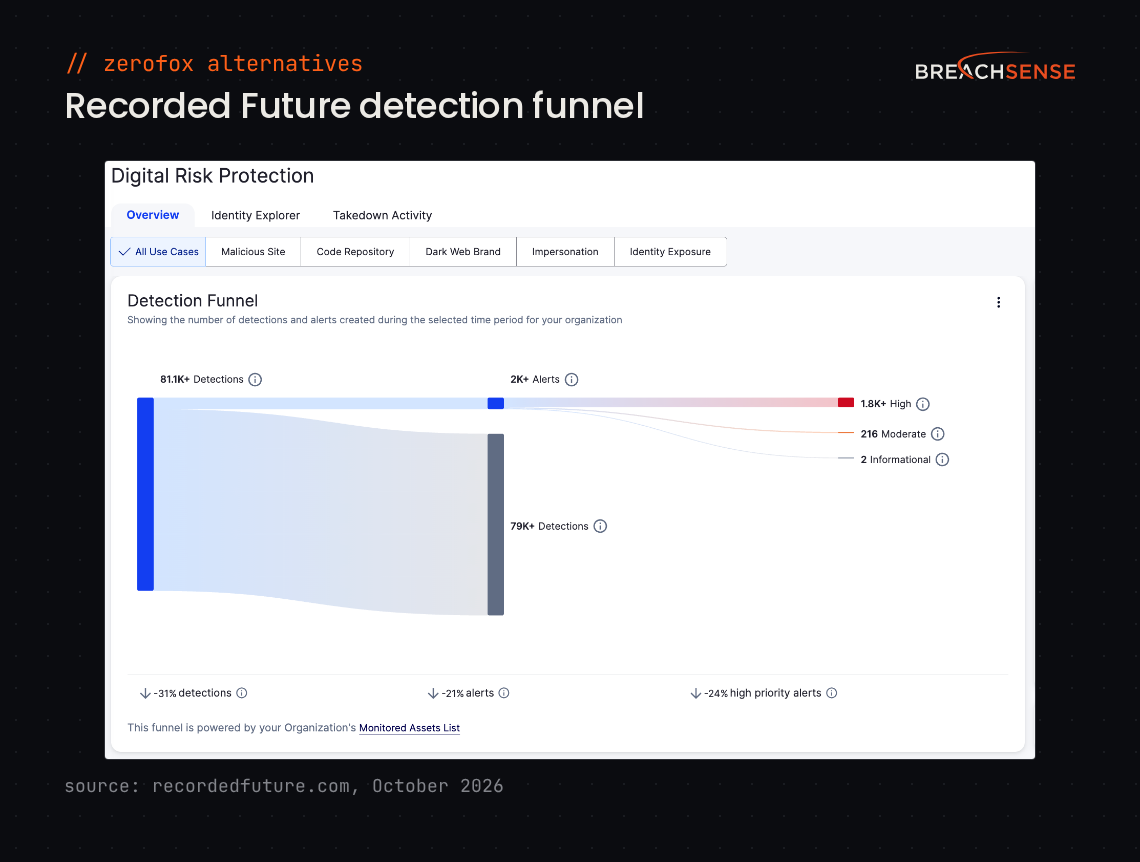
Recorded Future is a broad threat intelligence platform covering geopolitical risk and nation-state actors alongside dark web monitoring. It suits government agencies and large enterprises with dedicated threat intelligence analysts. The trade-off is complexity: it is a research platform that needs analyst time to operate. See Recorded Future alternatives for a closer look.
Recorded Future says it finds “1.3 million novel exposed login credentials per day.”
Key features
- Identity Intelligence. Finds exposed credentials in infostealer logs, malware combo lists and database dumps.
- Intelligence Graph. Connects Recorded Future’s datasets and powers nine Recorded Future products. You can query the Intelligence Graph through an API.
- Brand Intelligence. Alerts you to typosquat domains, code leaks and dark web discussions of your brand, and lets you start the takedown process.
- Threat Intelligence. Shows attackers’ infrastructure, techniques and targets, so you can tune your security controls.
Rating: 4.5/5 on G2
Pros
- Integrates with SIEM and SOAR tools, the systems that collect your security logs and run your response playbooks.
- Shows a risk score and the reason for it when an IP, domain or vulnerability appears in an alert.
- Lets you check many indicators of compromise, such as suspicious IP addresses and domains, at once through the API.
Cons
- Expensive, and identity intelligence, brand protection and third-party risk often need separate add-on licenses.
- Hard to learn at first. The query language is complex.
- Alerts need tuning to avoid a flood of minor notifications.
Flare
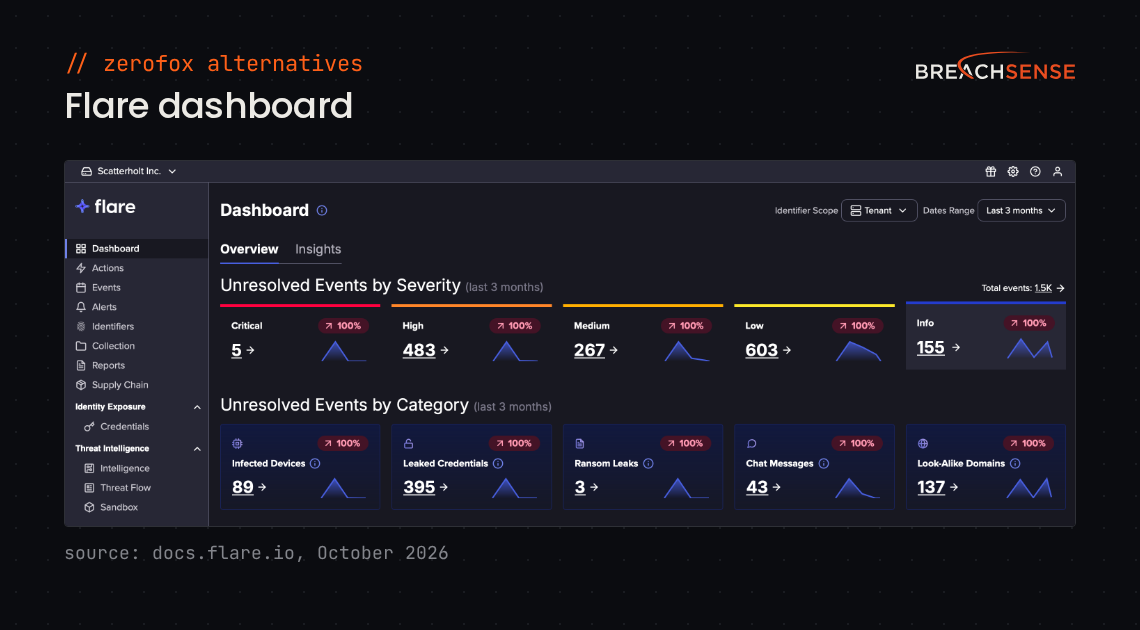
Flare monitors the dark web, Telegram and stealer logs for leaked credentials. Flare sells to mid-market and enterprise security teams. See Flare alternatives for more.
Flare says it has collected 159 million stealer logs and monitors over 100 ransomware leak sites.
Key features
- Identity Exposure Management. Checks whether leaked passwords still work in Microsoft Entra ID or Okta, then revokes sessions or disables the account.
- Phishing kit monitoring. Monitors the Telegram groups where phishing kits send the credentials they steal.
- Dark web monitoring. Monitors cybercrime channels on Telegram, Tor and I2P, an anonymous network similar to Tor.
- Session cookie detection. Flags stolen session cookies and lets you revoke the sessions from Flare.
Rating: 4.7/5 on Gartner Peer Insights
Pros
- Easy to set up, and analysts don’t need deep technical knowledge to investigate what Flare finds.
- Almost everything you can do in the web console, you can also do through the API.
- Support is responsive and open to feature requests.
Cons
- You can’t write your own rules for acting on a finding, so you’re limited to the actions Flare suggests.
- Integrations with other security tools are limited.
- A credential you’ve dismissed can come back later in a new event.
DarkOwl
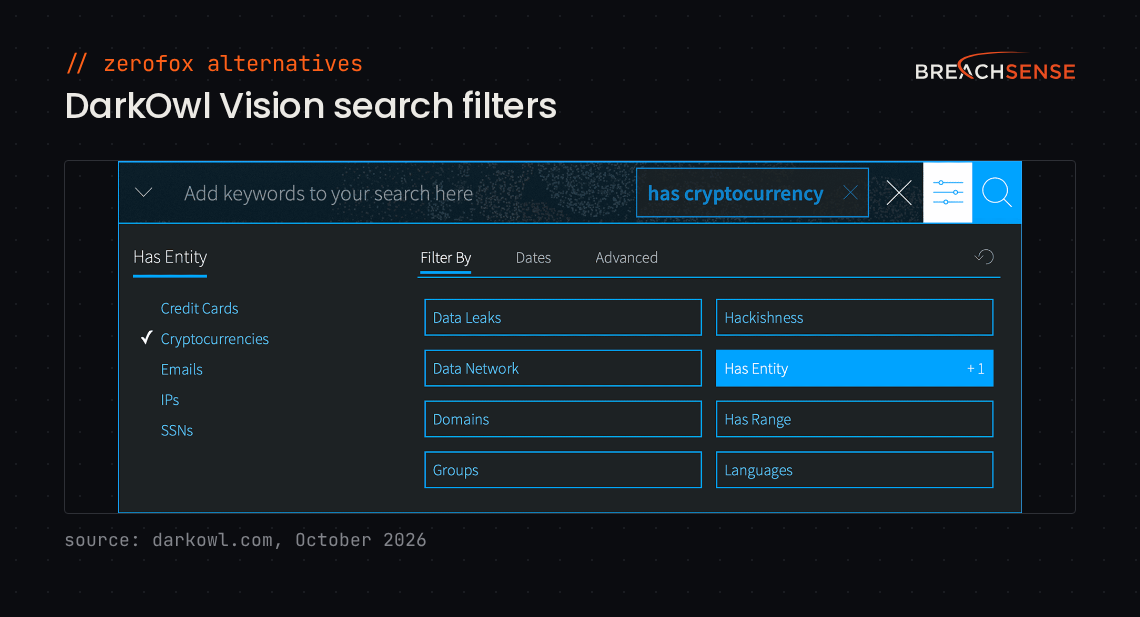
DarkOwl provides a large darknet data lake aimed at investigators and analysts. Its strength is searchable raw data for research and attribution work. For purpose-built credential alerting, other tools fit better. See DarkOwl alternatives.
DarkOwl says it collects 227,500 darknet pages per hour.
Key features
- Vision UI. Lets analysts search, monitor and set alerts on darknet data through a web interface.
- Search API. Lets you query DarkOwl’s full dataset, including 8+ years of archived darknet content, from your own tools.
- Entity API. Returns exposed data for an email address or domain, including whether a password leaked hashed or in plaintext.
- DarkSonar API. Gives a relative risk rating for an organization’s credential exposure on the darknet.
Rating: Not enough reviews on G2
How Should You Evaluate a ZeroFox Alternative?
Before you commit to any vendor, ask these three questions.
What Are You Actually Trying to Detect?
The real question is which categories you need covered. ZeroFox handles brand, social, and executive threats that Breachsense doesn’t, so if brand abuse and social impersonation are your main risks, ZeroFox is a better fit. If credential exposure and leaked files are your main risks, ask each vendor whether it covers leaked API keys, passwords typed into phishing pages and full-text search inside those files.
How Does It Integrate With Your Stack?
Ask whether the API covers everything the platform does or only part of it, whether webhooks support real-time alerting, and whether you can integrate in hours. API-first platforms save time for teams building automated response.
Who Operates It?
Some platforms assume a staffed SOC that can triage analyst-vetted intelligence. Others deliver specific alerts a smaller team can act on directly. Match the operating model to the team you actually have.
Is Breachsense the Right ZeroFox Alternative for You?
ZeroFox is a capable digital risk protection platform. It does brand, social, and executive coverage well for organizations that need breadth across the external attack surface.
Key takeaways:
- ZeroFox is strongest at brand protection and social media monitoring
- Breachsense adds leaked API keys, phished passwords and full-text search across leaked files
- Alternatives like Recorded Future, Flare, and DarkOwl serve different use cases
- Match the platform to your primary threat, not the longest feature list
If you need to search leaked documents or want focused credential intelligence with an API you can integrate quickly, Breachsense fills those gaps. If brand and social threats are your priority, ZeroFox covers threats Breachsense doesn’t.
Want to see what’s exposed? Check your dark web exposure or book a demo to see how Breachsense’s full-text search works on real leaked data.