Recorded Future Alternatives & Competitors (2026)
Quick Summary
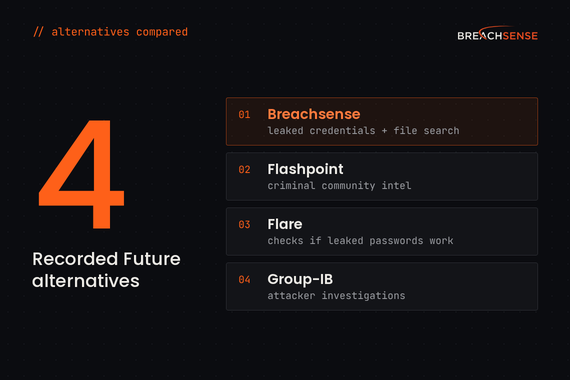
The best Recorded Future alternatives are Breachsense, Flashpoint, Flare and Group-IB. Pick Breachsense for leaked credentials and full-text search of leaked files, Flashpoint for intelligence from criminal communities, Flare for checking whether leaked passwords still work, or Group-IB for attacker investigations.
| Tool | Best for | Rating |
|---|---|---|
| Breachsense | Teams that want leaked credentials plus full-text search of leaked files, through an API | 4.8/5 (G2) |
| Flashpoint | Teams that want intelligence from hard-to-reach criminal communities, plus Flashpoint analysts who research questions on request | 4.5/5 (G2) |
| Flare | Teams that want to check whether leaked passwords still work in Microsoft Entra ID or Okta, then revoke sessions or disable the account | 4.7/5 (Gartner Peer Insights) |
| Group-IB | Teams that want help investigating attackers, from a vendor that works with Interpol and Europol | 4.7/5 (G2) |
Recorded Future Covers Far More Than Leaked Credentials
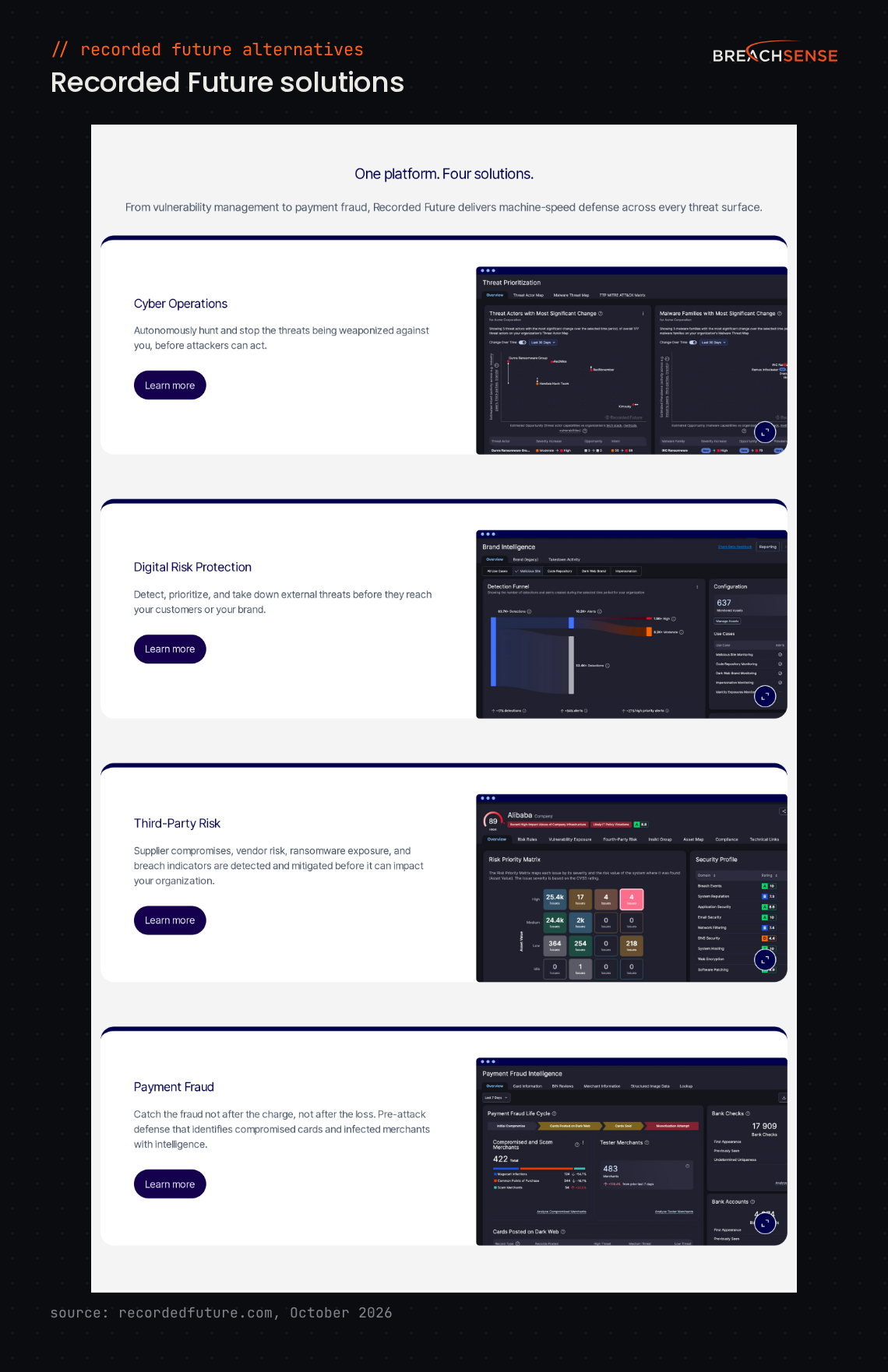
Recorded Future sells its platform as four product lines, named Cyber Operations, Digital Risk Protection, Third-Party Risk and Payment Fraud. Leaked credentials are covered by one module, Identity Intelligence.
Recorded Future’s breadth suits teams with analysts to run the platform.
Last reviewed October 15, 2026. Facts about Recorded Future come from recordedfuture.com, and ratings from G2 and Gartner Peer Insights.
What Does Recorded Future Do Well?
Recorded Future is an enterprise threat intelligence platform built to cover a wide range of threats in one place and turn raw data into analyst-written reports.
Founded in 2009, Recorded Future was acquired by Mastercard in 2024 for $2.65 billion. Its Intelligence Graph aggregates open web and dark web data, then layers analyst and machine-learning output on top to produce reports and attacker profiles.
The platform serves large enterprises and government agencies that need strategic intelligence for board reporting and tactical intelligence for security operations. Core use cases include:
- Geopolitical risk assessment for multinational organizations
- Nation-state threat tracking for government and critical infrastructure
- Vulnerability prioritization based on exploitation intelligence
- Brand monitoring across open and dark web sources
- Third-party risk intelligence on vendor ecosystems
Why Do Teams Look for Recorded Future Alternatives?
Recorded Future is a strong platform for the right buyer. Two common needs push teams to evaluate alternatives.
Your Primary Risk Is Credential Exposure
Recorded Future covers credentials as one part of a much wider platform. Verizon’s 2026 Data Breach Investigations Report looked at ransomware victims that had a credential or infostealer leak in the year before the attack (page 44). For half of those victims, the leak came in the 95 days before the attack. That 95-day window is why depth and speed on credential data matter more than breadth.
If account takeover is your main concern, a platform built specifically around stealer logs, combo lists, and third-party breaches gives you deeper coverage of that one vector.
You Don’t Have Analysts to Tune Alerts
On G2, Recorded Future users say the query language is hard to learn and alerts are noisy until tuned. Breachsense has no query language to learn. You add your domains and email addresses. We send an alert for every leaked credential that matches your domains or email addresses.
How Does Breachsense Compare to Recorded Future?
Breachsense goes deep where Recorded Future goes broad. It focuses on credentials and leaked files, then makes that intelligence easy to integrate and act on.
| Capability | Recorded Future | Breachsense |
|---|---|---|
| Credential monitoring | Yes | Yes |
| Stealer log coverage | Yes | Yes |
| Criminal forum monitoring | Yes | Yes |
| Leaked ransomware files | File metadata from 100+ extortion sites, plus a search for API secrets | Full text, searchable by any string |
| Credentials from phishing kits | No | Yes |
| Search of unsecured database leaks | No | Yes |
| Geopolitical intelligence | Yes | No |
| Nation-state tracking | Yes | No |
| Vulnerability intelligence | Yes | No |
| API | Documented REST API | API-first; alerts by webhook or email |
| Password resets | Built in, via Okta, Microsoft Entra ID and SOAR | Your own tools, from Breachsense’s webhook |
| Pricing | On request | On request |
| Before you buy | Free Identity Exposure Assessment; demo center | Free dark web scan; trials are available after a demo call |
| G2 rating, October 2026 | 4.5/5 | 4.8/5 |
What Recorded Future and Breachsense Each Cover
Both platforms cover stealer logs, session cookies, criminal forums, Telegram channels, ransomware leak sites and API secrets in leaked files.
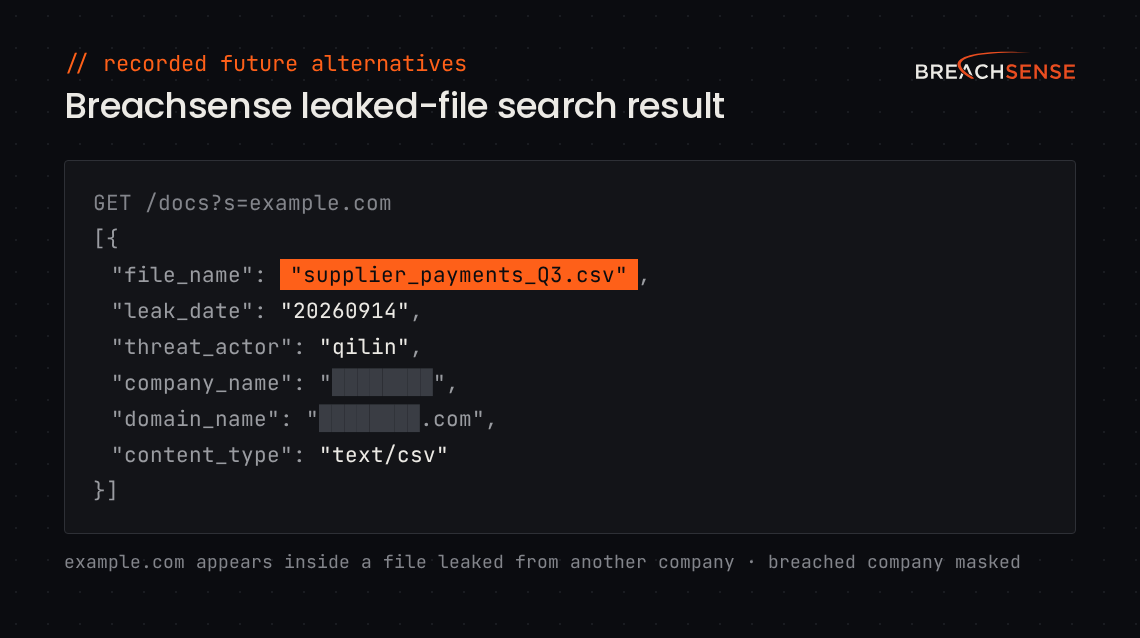
Document search. Of the two, only Breachsense lets you search the full text of leaked files, including files from a supplier’s breach. We also send an alert when a term you monitor shows up in a leaked file.
Geopolitical and vulnerability intelligence. Only Recorded Future covers these.
Who Should Choose Recorded Future, and Who Should Choose Breachsense?
Recorded Future is the better buy for these teams.
You need political-risk or nation-state context. Recorded Future tracks geopolitical risk and nation-state actors, which Breachsense doesn’t cover.
Your analysts want a research platform. Breachsense sends findings you can act on. Recorded Future gives your analysts a web console to research threats in. Breachsense is API-only.
You want vulnerability intelligence and credential monitoring from one vendor. Recorded Future offers both. We don’t offer vulnerability intelligence.
You need a report for the board. Our API returns JSON, so turning findings into a board slide is work your team does itself.
Breachsense is the better buy for these teams.
You need to search inside leaked files. We index the full text of files leaked by 100+ ransomware groups, plus files from third-party breaches and unsecured databases. You can search those files for any name or keyword.
You want alerts in the tools your team already uses, with little setup. We send alerts by webhook. Your tools can also pull them from our dark web monitoring API. There’s nothing to install. You get a license key and example API queries.
What Other Recorded Future Competitors and Alternatives Exist?
Recorded Future is one option among several. For a broader category view, see our cyber threat intelligence tools roundup. Here are the main alternatives teams evaluate.
Flashpoint
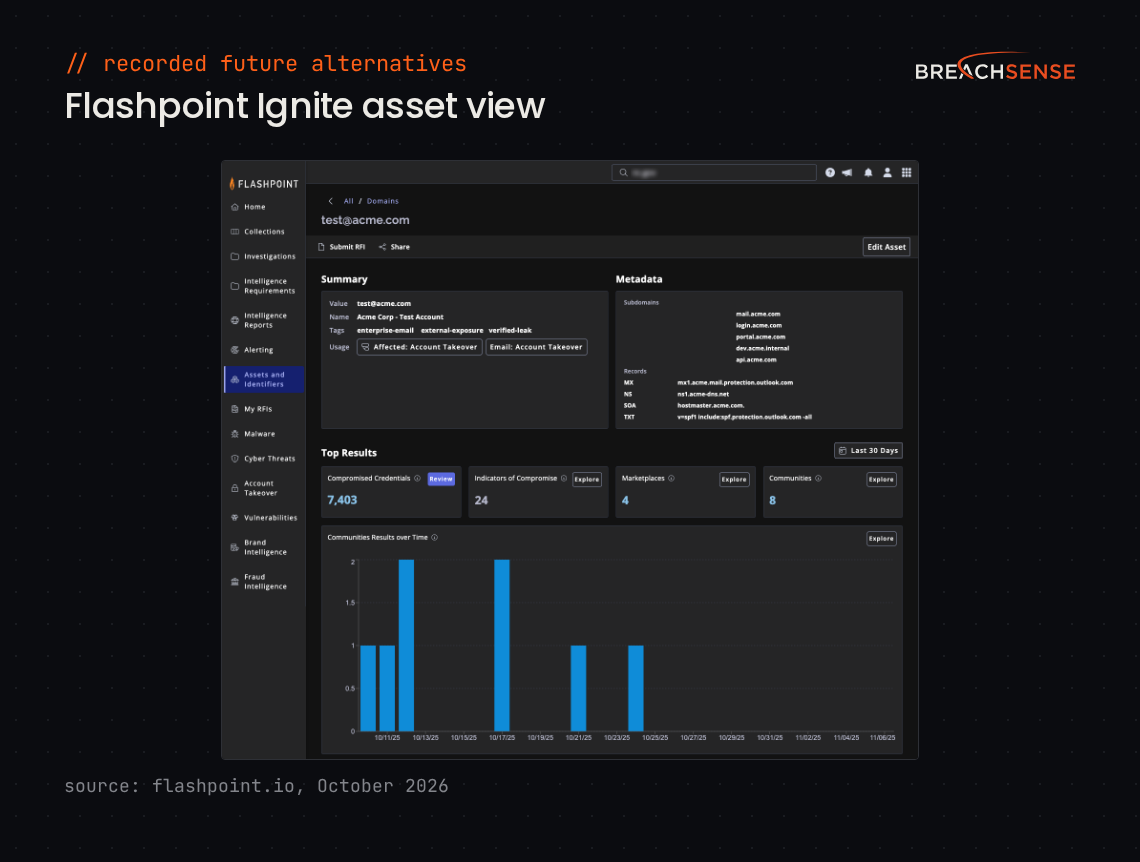
Flashpoint focuses on intelligence from illicit online communities and the deep and dark web. It suits teams that want analyst-curated coverage of adversary activity. Like Recorded Future, it is a broad platform that rewards dedicated analyst time.
Flashpoint says it keeps an archive of over 80 billion credential pairs. Flashpoint’s infostealer data comes from more than 42 million infected devices.
Key features
- Primary Source Collection. Collects intelligence directly from hard-to-reach criminal communities and private channels.
- Account Takeover module. Monitors compromised credentials, cookies and infostealer logs across Flashpoint’s collections.
- Ransomware and extortion tracking. Tracks active ransomware groups, their communication channels and illicit marketplaces.
- Finished intelligence and RFIs. Delivers analyst-written reports and answers requests for information (RFIs), the questions your team sends to Flashpoint’s analysts.
Rating: 4.5/5 on G2
Pros
- Analysts answer RFIs quickly. Flashpoint’s finished reports are thorough.
- Adds Telegram channels and forums to Flashpoint’s collection when you ask.
- Alerts can go to Slack or to your SOAR tool.
Cons
- Keyword alerts are noisy until tuned, and tuning them takes significant work with your Flashpoint customer success manager.
- RFIs are billed in hourly credits, which makes a year’s budget hard to plan.
- Search works differently in different parts of the platform.
Flare
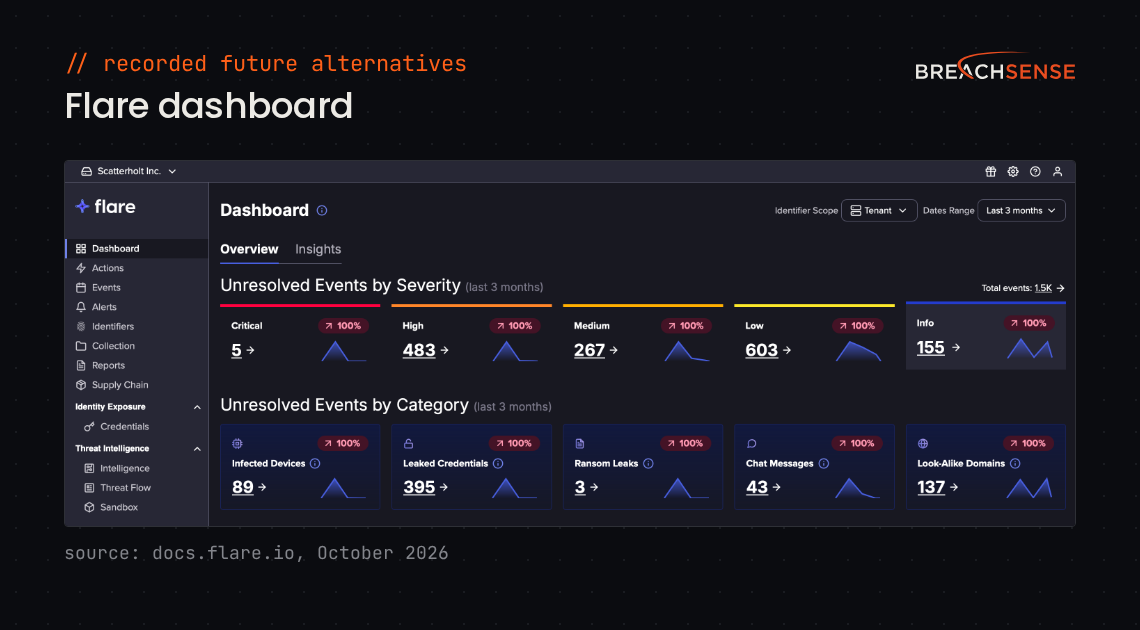
Flare monitors the dark web, Telegram and stealer logs for leaked credentials. Flare sells to mid-market and enterprise security teams. See Flare alternatives.
Flare says it has collected 159 million stealer logs and monitors over 100 ransomware leak sites.
Key features
- Identity Exposure Management. Checks whether leaked passwords still work in Microsoft Entra ID or Okta, then revokes sessions or disables the account.
- Phishing kit monitoring. Monitors the Telegram groups where phishing kits send the credentials they steal.
- Dark web monitoring. Monitors cybercrime channels on Telegram, Tor and I2P, an anonymous network similar to Tor.
- Session cookie detection. Flags stolen session cookies and lets you revoke the sessions from Flare.
Rating: 4.7/5 on Gartner Peer Insights
Pros
- Easy to set up, and analysts don’t need deep technical knowledge to investigate what Flare finds.
- Almost everything you can do in the web console, you can also do through the API.
- Support is responsive and open to feature requests.
Cons
- You can’t write your own rules for acting on a finding, so you’re limited to the actions Flare suggests.
- Integrations with other security tools are limited.
- A credential you’ve dismissed can come back later in a new event.
Group-IB
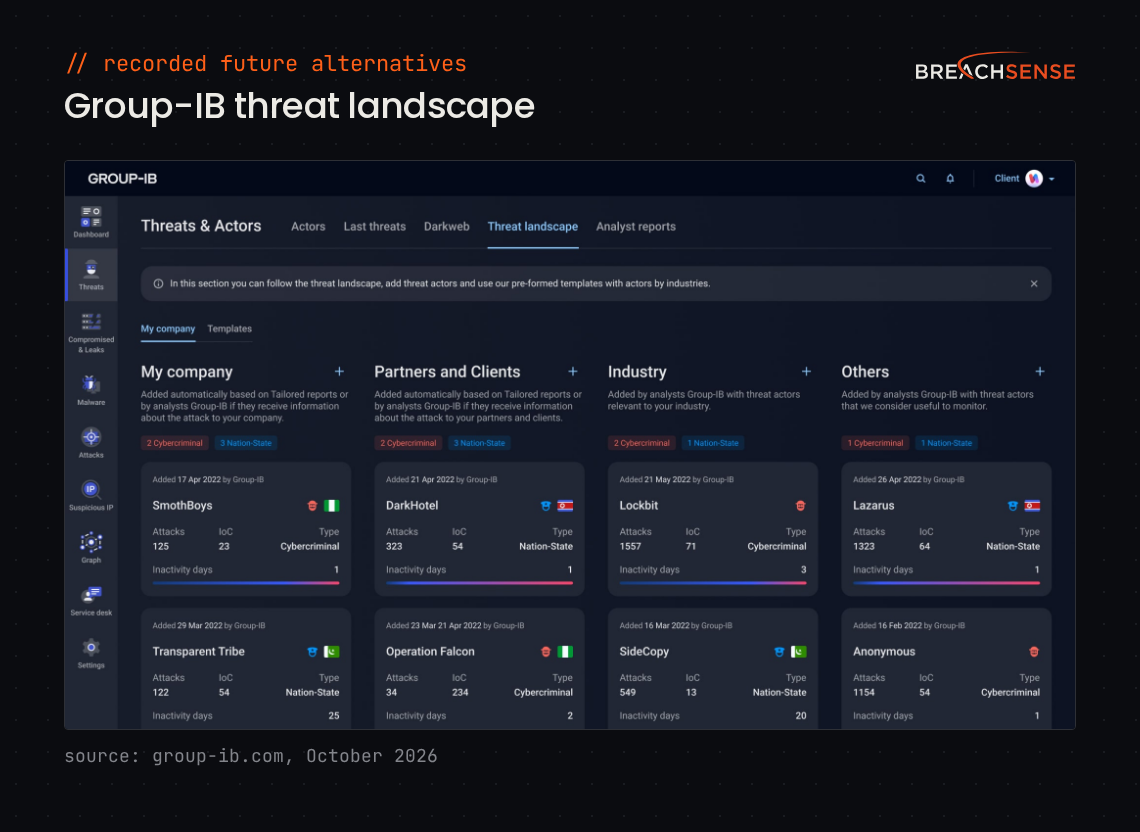
Group-IB is strong at attacker tracking and investigations, for teams that want to know who’s targeting them. See Group-IB alternatives.
Group-IB says it has completed over 1,600 investigations and works with Interpol and Europol.
Key features
- Data leaks. Finds compromised credentials, including executives’ personal accounts, plus payment cards and breach databases. Alerts you when your company’s data turns up.
- Attribution. Profiles threat actors’ methods and infrastructure, mapped to MITRE ATT&CK, a public catalog of attacker techniques.
- Graph. Maps the links between threat actors, their infrastructure and the tools they use.
- Dark web. Alerts you when your company, or a topic you choose, is discussed on the dark web.
Rating: 4.7/5 on G2
Pros
- Analysts give a fast first answer to RFIs.
- Threat actor profiles show which groups target your industry.
- Reports leaked payment card numbers quickly.
Cons
- Information is scattered across the interface.
- Some sections are hard to use without help from Group-IB’s analysts.
- Thin coverage of some countries, such as Vietnam and the Dominican Republic.
How Should You Evaluate a Recorded Future Alternative?
Before you commit to any vendor, ask these three questions.
Do You Need Strategic Intelligence or Credential Alerts?
Strategic intelligence for board reporting and APT attribution is a different product from credential alerts your team can act on today.
What Resources Will Operate It?
Broad platforms assume analysts who can turn intelligence into action. If you don’t have that team, a platform that sends a specific finding (the user, the password, the source) into your existing tools is easier to act on.
How Fast Do You Need It Working?
If you need coverage live this quarter, weigh implementation time heavily. Ask each vendor how long a typical setup takes. Most of our customers finish their first integration in under an hour.
Is Breachsense the Right Recorded Future Alternative for You?
Recorded Future suits organizations that need broad, analyst-driven intelligence and have the team to operate it.
Key takeaways:
- Recorded Future is built for broad strategic intelligence including geopolitical and nation-state coverage
- G2 reviewers say it takes time to learn
- Breachsense goes deep on credentials and leaked files with full-text search and fast API integration
- Alternatives like Flashpoint, Flare, and Group-IB serve different use cases
If you want alerts on leaked credentials and leaked files in your own tools, Breachsense’s dark web monitoring is the better fit. If you need geopolitical and nation-state intelligence, Recorded Future is the stronger choice.
Want to see what’s exposed? Check your dark web exposure or book a demo to see how Breachsense’s full-text search works on real leaked data.