Intel 471 Alternatives & Competitors (2026)
Quick Summary
The best Intel 471 alternatives are Breachsense, Flashpoint, Recorded Future and Flare.
| Tool | Best for | Rating |
|---|---|---|
| Breachsense | Teams that want alerts on leaked credentials and session tokens, plus full-text search of leaked files | 4.8/5 (G2) |
| Flashpoint | Analyst teams that research criminal communities and send Flashpoint’s analysts questions | 4.5/5 (G2) |
| Flare | Teams that want to check whether leaked passwords still work in Microsoft Entra ID or Okta, then revoke sessions or disable the account | 4.7/5 (Gartner Peer Insights) |
Intel 471 Is Built for Intelligence Analysts
Intel 471 aims its platform at analyst teams. Its platform overview promises to “upskill and amplify your analysts” with more than 700 ready-made threat hunts.
If your team mainly needs alerts on leaked data, compare what Intel 471’s credential alerts contain with a tool built around that data.
Last reviewed October 15, 2026. Facts about Intel 471 come from intel471.com and its official API SDKs. Ratings come from G2 and Gartner Peer Insights.
What Does Intel 471 Do Well?
Intel 471’s sources include underground marketplaces, infostealer logs and conversations with threat actors in closed forums.
- Threat actor profiles. Follows criminal groups over time and documents how they operate.
- Malware intelligence. Tracks over 285 malware families and their command-and-control servers.
- Credential intelligence. Collects leaked credentials from marketplaces, third-party breaches and infostealer logs. Its alerts include the password in plaintext.
- Exposure modules. Find exposed systems you own, risks at your third parties and lookalike domains that abuse your brand.
Why Do Teams Look for Intel 471 Alternatives?
You Want to Search the Text Inside Leaked Files
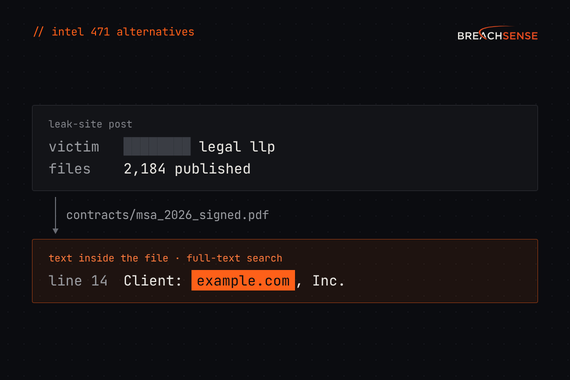
Intel 471 has keyword alerts for data leak sites, which it calls watchers. A watcher sends an alert when your keyword shows up in a leak-site post, including in text inside an attached image. Intel 471 also lists the files a leak site has published. None of Intel 471’s documented API endpoints lets you search the text inside those files.
When a supplier is breached, the leak-site post names the supplier, not you. Your data is inside the supplier’s leaked files.
Breachsense indexes the full text of files leaked in ransomware attacks, third-party breaches and unsecured databases. You can search them for any term. We send an alert when a term you monitor shows up in a new file.
You Want Alerts on Stolen Session Tokens
Intel 471’s credential alerts include the plaintext password and details about the infected machine. Intel 471’s API documentation doesn’t list session tokens in its credential data.
With a stolen session token, an attacker can log in without the password or MFA. With Breachsense, you choose which session cookies to monitor. We send an alert when one of them shows up in a stealer log.
How Does Breachsense Compare to Intel 471?
| Capability | Intel 471 | Breachsense |
|---|---|---|
| Leaked credentials | Yes, with plaintext passwords | Yes, with plaintext passwords. Password hashes from breaches are cracked where possible |
| Stealer log coverage | Yes | Yes |
| Session tokens from stealer logs | Not listed in its API documentation | Yes |
| Full-text search of leaked files | Not listed in its API documentation. Watchers cover leak-site posts | Yes, searchable by any term |
| Attack surface and lookalike domains | Yes, in its exposure modules | Yes |
| Threat actor profiles | Yes | No |
| Malware and command-and-control tracking | Yes | No |
| Vulnerability intelligence | Yes | No |
| How you get the data | Web platform, API, email and SIEM or SOAR integrations | Webhook and email alerts, plus a REST API |
| Pricing | On request | On request |
Who Should Choose Intel 471, and Who Should Choose Breachsense?
Choose Intel 471 If
You research the groups behind attacks. Intel 471 profiles threat actors and tracks their malware. Breachsense does neither.
You want analysts without hiring them. Intel 471 sells Embedded Collection Management. Senior Intel 471 analysts are assigned to your account. They decide what intelligence to collect and send you, based on the threats you face. Breachsense sends alerts and leaves the analysis to your team.
Choose Breachsense If
You need to search inside leaked files. You can search them for your domain or a client’s, or for an employee’s email address.
What Other Intel 471 Competitors and Alternatives Exist?
See our cyber threat intelligence tools roundup for a wider list.
Flashpoint
Flashpoint collects intelligence from criminal forums, ransomware sites and closed Telegram channels, and sells it through its Ignite platform. Flashpoint’s own analysts also answer research questions you send them. Of the alternatives here, Flashpoint is the closest match to Intel 471’s research focus.
Key features
- Cyber Threat Intelligence package. Covers criminal communities and ransomware groups.
- Account Takeover. Monitors compromised credentials, cookies and infostealer logs.
- Requests for information (RFIs). Flashpoint’s analysts research questions your team sends them, billed in hourly credits.
- Managed Attribution. An anonymous browser or virtual machine for visiting criminal sites without exposing who you are.
Rating: 4.5/5 on G2
Pros
- Shows the original criminal posts and screenshots, so analysts can verify a threat themselves.
- Finished intelligence reports are thorough and timely.
- You can ask Flashpoint to add new sites and channels to its collection.
Cons
- RFI cases are handled by email only, with no chat channel.
- Keyword alerts built on Boolean logic produce many false positives until tuned with Flashpoint’s team.
- You can’t save a list of names or values and reuse it across queries.
Recorded Future
Recorded Future, owned by Mastercard since December 2024, is a broad intelligence platform like Intel 471. It can also reset exposed passwords through your identity and SOAR platforms. See Recorded Future alternatives.
Recorded Future says it finds 1.3 million new exposed credentials a day.
Key features
- Identity Intelligence. Finds exposed credentials in infostealer logs, combo lists and database dumps.
- Geopolitical intelligence. Covers geopolitical events and country risk alongside cyber threats.
- Intelligence Graph. Links IP addresses, domains and other indicators to the threat actors and campaigns behind them.
- Third-Party Risk. Flags your suppliers when they show signs of a breach.
Rating: 4.5/5 on G2
Pros
- Checking an IP address or CVE shows a risk score and the evidence behind it.
- The Intelligence Graph links related indicators, so analysts don’t have to check each one by hand.
Cons
- Identity intelligence and other key capabilities are sold as separate add-on modules.
- The query language is hard to learn, especially if you don’t use it every day.
- Some risk scores are hard to interpret without opening the evidence.
Flare
Flare matches your identifiers against forums, markets, Telegram channels, stealer logs and paste sites. Its Identity Exposure Management add-on connects to Microsoft Entra ID and Okta. Flare offers a 2-week free trial after a video call to verify your identity. See Flare alternatives.
Flare says it monitors over 25 billion leaked credentials.
Key features
- Identity Exposure Management. Checks whether leaked passwords still work in Microsoft Entra ID or Okta, then revokes sessions or disables the account.
- Telegram monitoring. Covers cybercrime channels on Telegram alongside forums and markets.
- Session cookie detection. Flags stolen session cookies from stealer logs.
Rating: 4.7/5 on Gartner Peer Insights
Pros
- Penetration testers get extra detail from Telegram and phishing data to pass on to their clients.
- Almost everything you can do in the web console, you can also do through the API.
- The training material is thorough and suits beginners.
Cons
- Reports are available in English only.
- A leaked credential’s username and password are sometimes swapped.
- Doesn’t map out your suppliers’ own third parties.
How Should You Evaluate an Intel 471 Alternative?
Ask each vendor for a real alert from the last month. Check whether the password is in plaintext. Check whether the alert includes the infected machine’s details, so your team knows which device to clean up. Then check for the stolen session token, so your team can revoke the session after the password reset.
Next, ask whether you can search the text inside leaked files, or only see that a leak-site post names a company.
Is Breachsense the Right Intel 471 Alternative for You?
If your team researches threat actors and malware, Intel 471 is built for that work. If you need alerts on your leaked credentials, or need to find your data in a supplier’s leaked files, Breachsense is the better fit.
Run a free dark web scan to see which of your credentials have leaked, or book a demo to try full-text search on real leaked files.